
AI Marketing Automation vs Traditional Marketing Automation: What’s the Real Difference?
Marketers throw both terms around as if they mean the same thing, but the gap between them is fundamental. AI marketing automation learns from behavioral data, predicts a customer’s next move, and adjusts campaigns in real time, while traditional automation simply executes fixed if/then rules a human wrote in advance, according to a comparison published by MarTech.

This guide breaks down both models, lines them up across eight measurable dimensions in one table, and shows where the real cost and ROI differences show up — plus when to run each one, or combine them.
What Is Traditional Marketing Automation?
Traditional marketing automation is software that fires a predefined sequence whenever a specific trigger occurs. In email marketing automation, this is the most familiar pattern: a welcome email goes out the moment someone registers, and a cart-abandonment reminder arrives a few hours after checkout stalls — not because the system understood the customer, but because a rule says so. Segmentation is static too: contacts get grouped by fixed fields like location, demographics, or purchase history, and every person in a segment receives the same generic message.
How rule-based workflows operate
The logic behind legacy automation is simple: «if this happens, then do that.» A webinar signup or a cart abandonment triggers a pre-written sequence of emails or texts that runs the same way for every contact, every time. That predictability makes rule-based automation reliable for repeatable processes, but it cannot adapt on its own — a workflow built for last year’s buying behavior keeps running unchanged until a marketer manually rewrites it. Tools like HubSpot workflows, Marketo Engage, and classic email service providers built their reputations on exactly this model.
Strengths and limits of the traditional model
Rule-based automation is cheaper and faster to deploy than AI-driven systems. It requires less setup, fewer integrations, and no ongoing model training — a marketer can map a workflow in an afternoon and know exactly what it will do next month. The trade-off shows up in flexibility, and it tends to surface in the same four places:
- Static segmentation by location, demographics, or purchase history — everyone in a group gets the same message
- No learning loop — the system never adjusts on its own as customer behavior changes
- Manual rework — every rule change requires a marketer to rebuild the workflow by hand
- Generic messaging at the group level, with no way to tailor content person by person
What Is AI Marketing Automation?
AI marketing automation software applies machine learning to the same marketing tasks, but instead of following a fixed script, it studies behavioral data across every touchpoint to figure out what a customer is likely to do next. Generative AI adds another layer, drafting and adjusting content on the fly rather than pulling from a static template library.
How machine learning changes the workflow
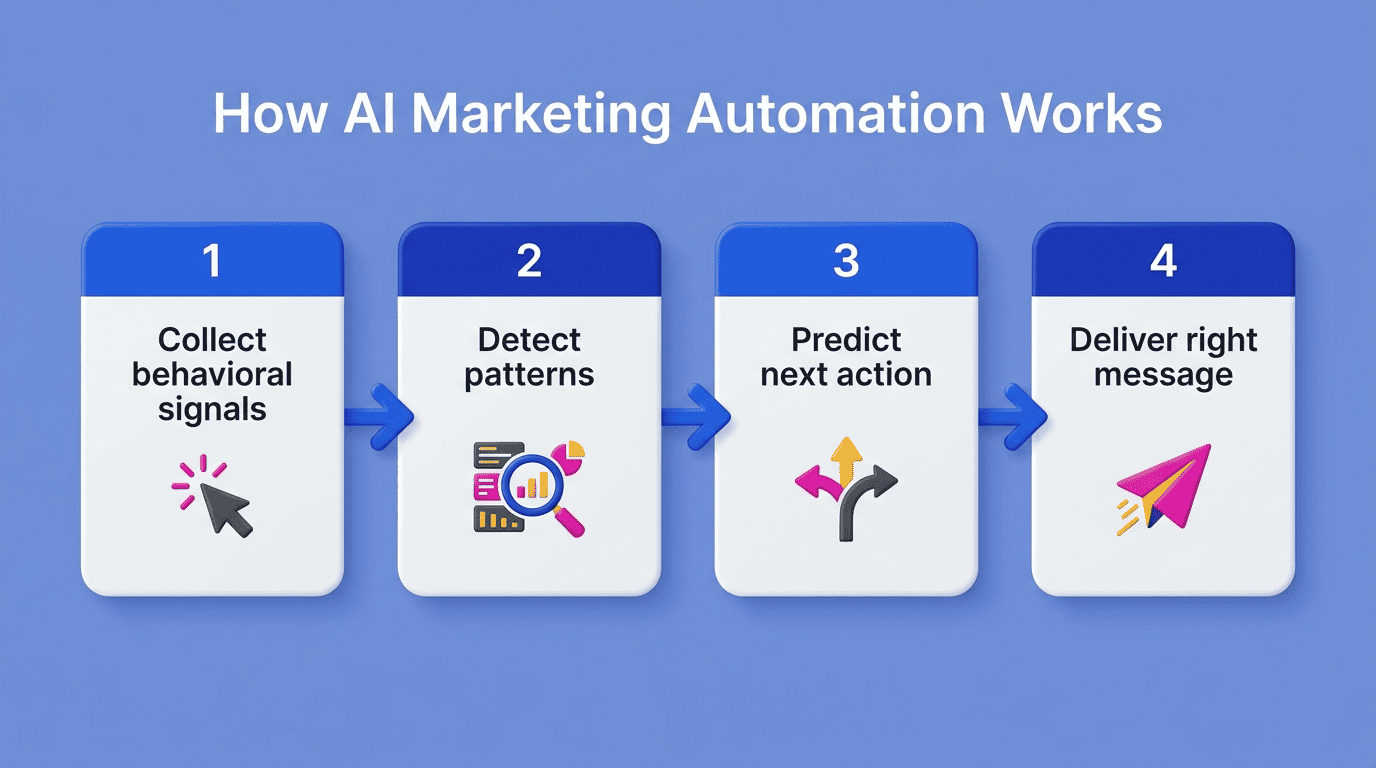
An AI-powered marketing automation platform analyzes behavioral signals from each interaction — clicks, dwell time, purchase sequences, support tickets — and looks for patterns a human would never spot manually. From those patterns it predicts the customer’s probable next action and selects the right message, the right channel, and the right moment to deliver it. Because the model keeps learning from outcomes, campaigns get refined continuously instead of waiting for a quarterly review.
What AI automation needs to work
None of that prediction happens without fuel. AI decisioning needs four things in place before it delivers real value:
- First-party behavioral data collected consistently across web, email, and app touchpoints
- Clean data integration so signals from separate systems actually connect to one customer profile
- Enough computing power to score and re-score audiences continuously, not once a quarter
- Governance to keep behavioral data compliant with regulations like GDPR and CCPA
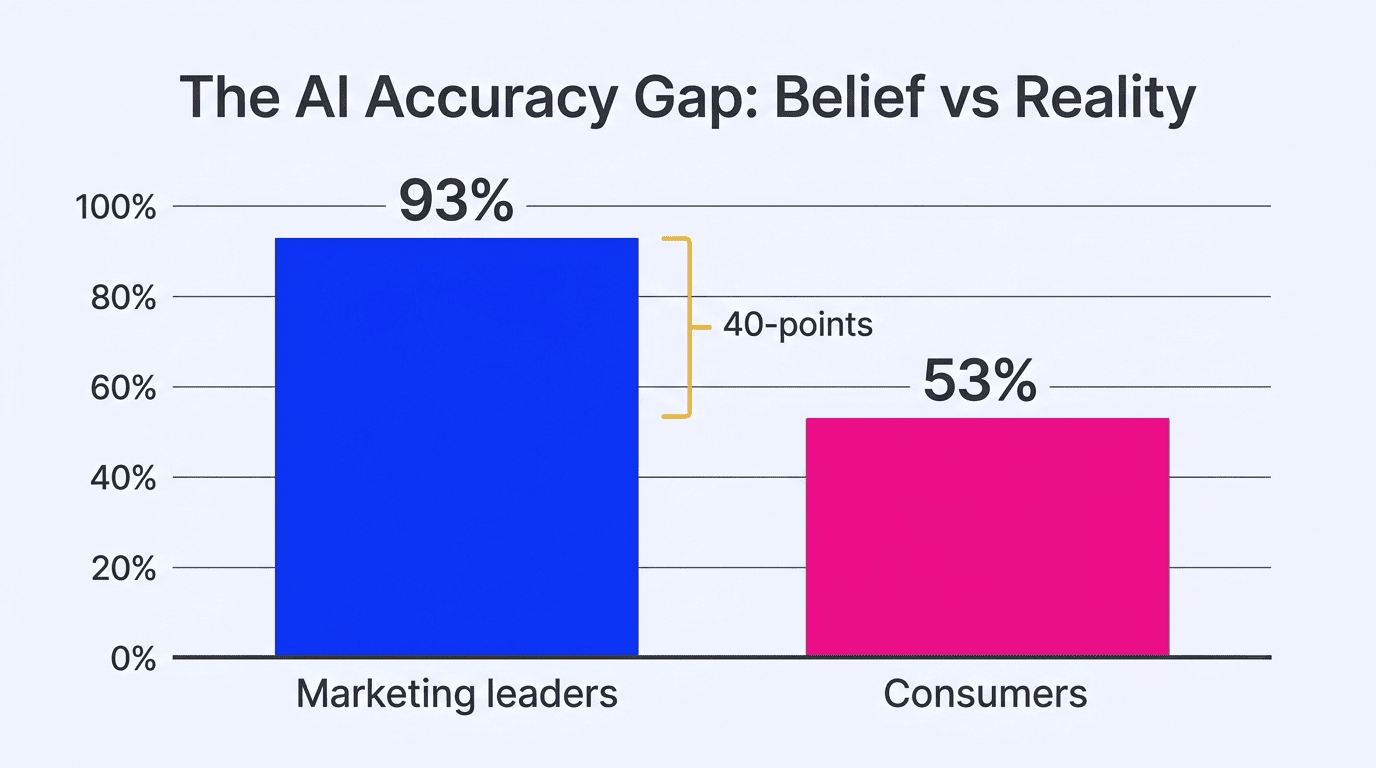
The gap between promise and perception is measurable. Braze’s 2026 research found that 93% of marketing leaders believe AI delivers more accurate customer insight, but only 53% of consumers actually feel that accuracy in the messages they receive — a 40-point gap that traces straight back to data quality.
Consumers expect personalization, but many marketers are still delivering generic content — 71% of consumers expect personalized interactions, and 76% get frustrated when they don’t happen.
McKinsey & Company
AI vs Traditional Marketing Automation: Head-to-Head Comparison
The clearest way to see the difference is side by side. Improvado’s breakdown of both models lines up eight dimensions that matter most to a marketing team choosing between them — from how decisions get made to how far each system can scale.
Comparison table across 8 dimensions
| Dimension | Traditional Automation | AI Marketing Automation |
|---|---|---|
| Logic | Fixed if/then rules | Learns and adapts from data |
| Data usage | Static fields (location, demographics) | Live behavioral data |
| Personalization | Segment-level, generic | Individual, real-time |
| Optimization | Manual A/B testing | Continuous, self-optimizing |
| Human input | High at setup and ongoing maintenance | Lower once trained, higher upfront integration |
| Scalability | Linear, limited by manual rework | Scales as data volume grows |
| Decision-making | Predefined by the marketer | Predictive, model-driven |
| Example | Welcome email on signup | Next-best-action recommendation |
Where popular platforms sit on the spectrum
Most marketing teams already run at least one of these platforms, and few are purely one model or the other — most sit somewhere in between, adding AI features on top of an originally rule-based core.
| Platform | Core model | Where AI shows up |
|---|---|---|
| HubSpot | Rule-based workflows, AI layered on top | Predictive lead scoring, content assistants |
| Marketo Engage | Rule-based, with predictive add-ons | Predictive content, behavior scoring |
| Salesforce Einstein | AI-native decisioning layer | Predictive lead scoring, next-best-action |
| Adobe Experience Platform | AI-native, real-time customer data platform | Real-time segmentation, generative personalization |
The practical takeaway is that the platform name matters less than which mode a given workflow is actually running in. A HubSpot account can run pure rule-based sequences for years before anyone turns on its predictive scoring, so the comparison between AI and traditional automation is really about which features are switched on, not which vendor logo is on the login screen.
Personalization and Segmentation: Static vs Real-Time
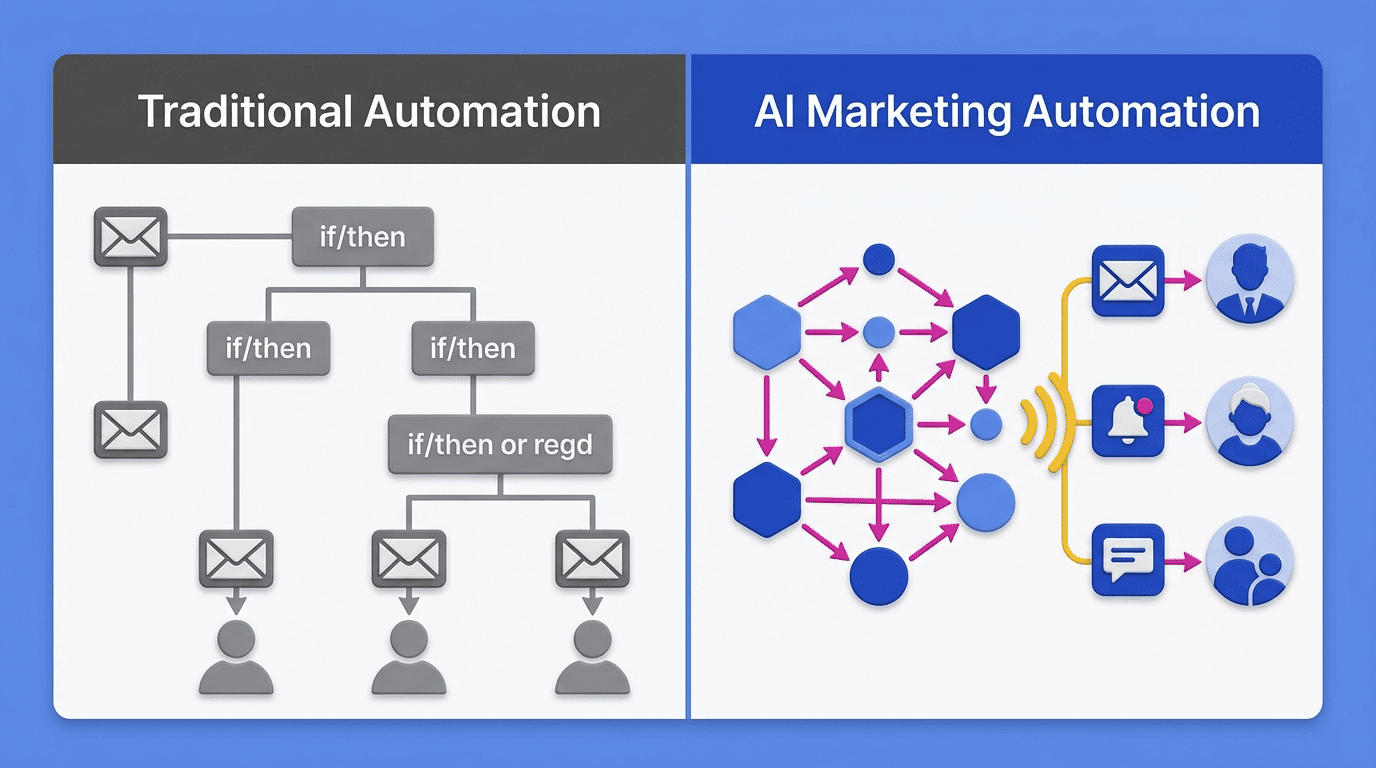
Segmentation is where the two models diverge most visibly to customers. Traditional systems slice an audience into fixed groups and send every member of a group the same content, no matter how their behavior shifts afterward.
From static segments to dynamic audiences
Traditional marketing automation divides an audience by fixed factors — age, region, past purchases — and delivers one predetermined message to everyone in that bucket. AI marketing automation instead reads live behavioral data and adjusts the contact dynamically, reshaping content, timing, and channel as a person’s behavior changes rather than locking them into a group forever. That shift is already mainstream: 77% of marketers now use AI-powered automation for personalized content, and 45% apply AI specifically to audience segmentation and targeting, according to GTM 80/20 research.
Lead Scoring: Rule-Based vs Predictive
Lead scoring shows the gap in dollar terms more clearly than almost any other use case, because it directly touches how sales teams prioritize their pipeline.
How AI scoring outperforms fixed points
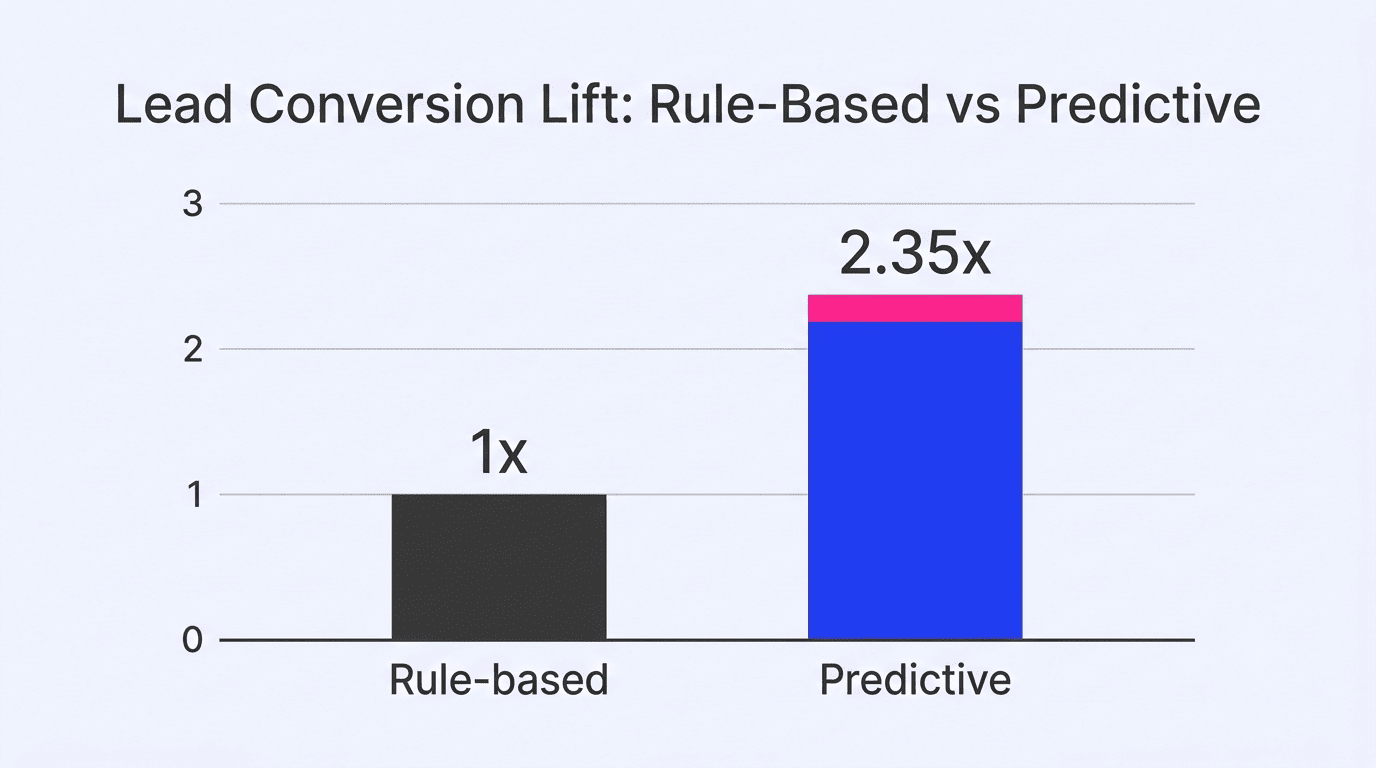
Traditional lead scoring assigns points for predefined actions — open an email, get 5 points; visit a pricing page, get 10 — a system that’s easy to configure but never adapts once it’s built. Predictive lead scoring analyzes many data sources at once and continuously refines its read on buying intent instead of relying on a fixed points table. U.S. Bank’s predictive lead-scoring deployment, built on Salesforce Einstein, produced a 2.35x lift in lead conversion and can score millions of leads in a matter of hours instead of days — a scale no manual points table could match.
Cost, Complexity, Data, and Governance
Choosing between the two models is also a budget and compliance decision, not just a technical one.
The real trade-off
Traditional automation stays cheaper, faster to deploy, and easier to predict because it has no model to train and no live data pipeline to maintain. AI marketing automation demands more computing power, tighter data integration, and governance around regulations like GDPR and CCPA — but in exchange it surfaces insight no rule set can generate on its own. McKinsey estimates that generative AI can add the equivalent of 5-15% of total marketing spend in productivity value, which is why teams that adopt it typically reallocate a meaningful share of the time execution used to consume back toward strategy and creative work.
To decide which model — or mix — fits a specific team, walk through the same checks in order:
- List every recurring campaign trigger (signup, cart abandonment, renewal) and confirm which ones truly need adaptive logic versus a fixed sequence.
- Audit how much first-party behavioral data is actually being captured today across email, web, and CRM systems.
- Check whether current tools (HubSpot, Marketo Engage, Salesforce Einstein, Adobe Experience Platform) already include AI decisioning that’s simply switched off.
- Estimate the compliance lift — GDPR/CCPA documentation, consent tracking — required to run behavioral data through a predictive model.
- Pilot AI on one high-volume use case, such as lead scoring or send-time optimization, before rolling it out account-wide.
- Keep the rule-based workflows that already work well for simple, predictable sequences instead of replacing them for the sake of it.
- Set a review cadence to compare AI-driven results against the previous rule-based baseline every quarter.
When to Choose Which — and How to Combine Them
Neither model wins in every situation, and most mature marketing teams end up running both rather than picking a single winner.
Traditional automation is enough for simple, predictable flows. Transactional confirmations, basic drip sequences, and one-time onboarding emails rarely benefit from a predictive model — the outcome is already known, so paying for machine learning adds cost without adding value.
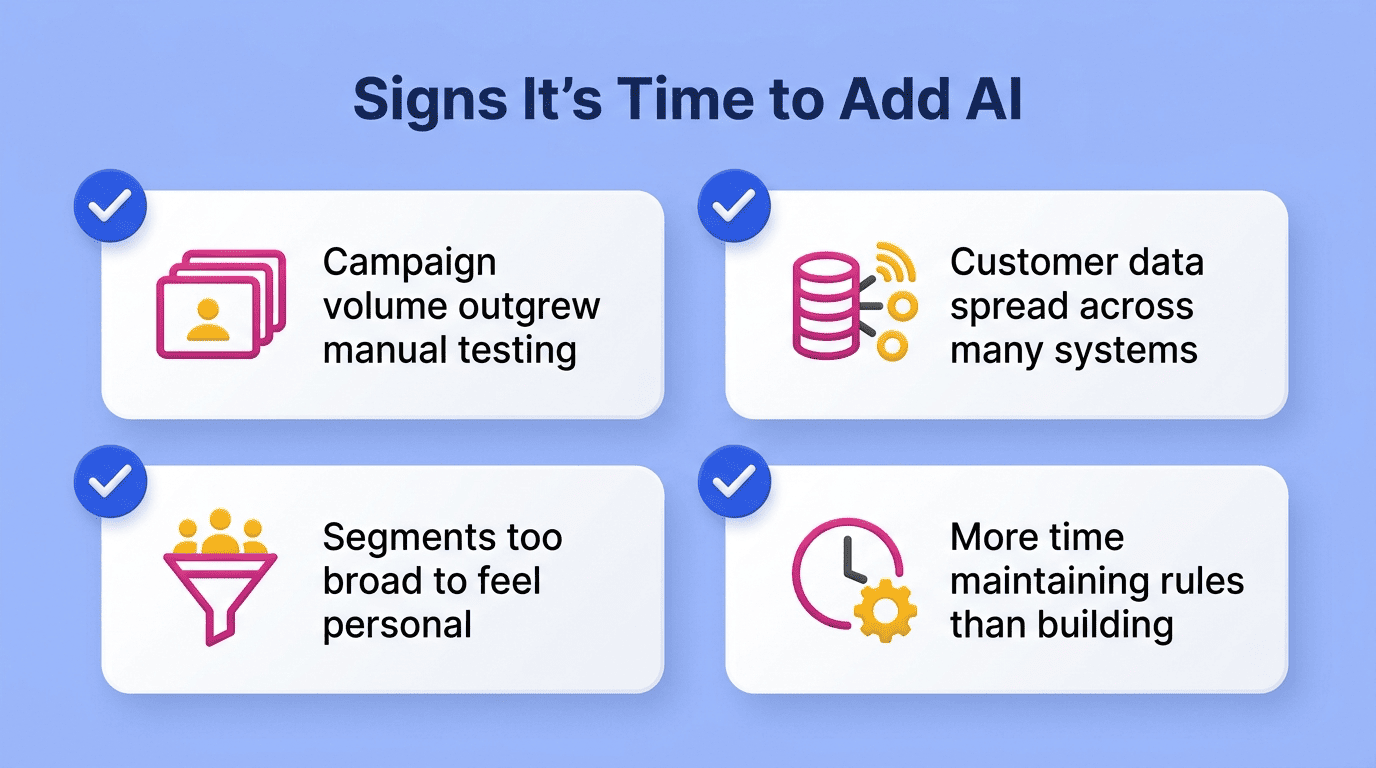
AI marketing automation pulls ahead once data volume, channel count, and personalization needs grow. A brand running dozens of simultaneous campaigns across email, ads, and messaging channels benefits from cross-channel orchestration — one model coordinating the message across every touchpoint instead of each channel running its own disconnected logic — and gets far more out of a system that learns than one that waits for a rule update. A handful of signals usually make the case:
- Campaign volume has grown past what a small team can manually A/B test and adjust
- Customer data now lives across multiple systems that need to be read together, not one at a time
- Segments have gotten too broad to feel personal, and open or click rates are flattening
- The team spends more time maintaining old rules than building new campaigns
The strongest strategy treats the two as complementary rather than competing: traditional automation handles the operational core — confirmations, reminders, core CRM workflows — while AI marketing automation layers scaled personalization and real-time decisioning on top. Teams that make this shift report saving 12 or more hours per week and launching campaigns up to 75% faster. One useful analogy: build the car first with traditional automation, then install the autopilot with AI.
Agentic AI — the next step beyond automation
Agentic AI marketing goes a step further than predictive automation. Instead of executing a rule or even a single prediction, an autonomous, goal-oriented agent runs a campaign the way a human campaign manager would. That typically means the agent can:
- Set its own sub-goals toward a broader objective, such as maximizing qualified pipeline
- Test multiple approaches to a task and keep the ones that perform
- Adjust strategy mid-campaign as new data comes in, without waiting for a person to approve each step
- Hand off only exceptions or high-risk decisions to a human reviewer
The market reflects how fast this is moving: agentic AI in the U.S. is valued at $2.43 billion in 2025 and is projected to reach $65.25 billion by 2034. It represents the next evolutionary stage after rule-based workflows and predictive, model-driven automation.