
AI Marketing Automation for Audience Segmentation: Build Smarter Segments in Minutes, Not Weeks
AI audience segmentation uses machine learning to group customers by behavior, intent, and value automatically — analyzing hundreds of variables at once and rebuilding segments in real time. With AI marketing automation, segments that once took analysts days to define now take minutes, and they keep updating themselves as customer behavior shifts, according to LiveRamp’s breakdown of how AI segmentation works.
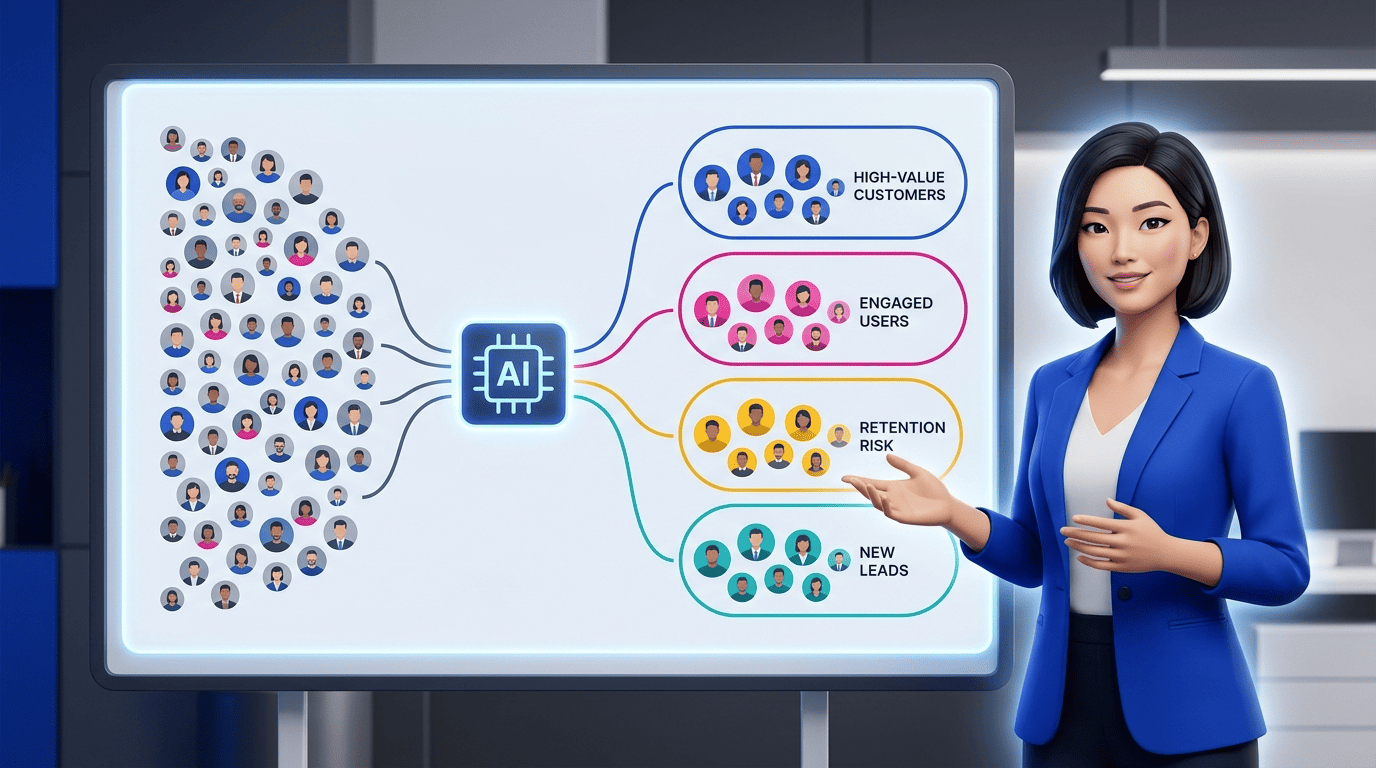
It works: brands that switch to AI-powered segmentation consistently report measurable lift — double-digit revenue and engagement gains in individual campaigns, and ROI running into the hundreds of percent in independently audited studies, as the case studies below show. This guide covers how the mechanism works, the segment types AI creates, the tools worth paying for, and how to roll it out without tripping over data quality or privacy law.
What Is AI Audience Segmentation?
AI audience segmentation is the practice of applying machine learning to customer data so an algorithm — not an analyst — decides who belongs in which group. It’s the engine behind most modern AI-powered marketing automation stacks, and it replaces spreadsheet rules with models that keep learning.
Definition
AI customer segmentation applies machine learning to first-party data to automatically group people by shared behavior, intent, demographics, and value — analyzing dozens to hundreds of variables at once, far beyond what manual rules can handle. It typically runs on a customer data platform (CDP) or marketing automation platform that unifies the data first, pulling in CRM records, website events, and transaction history into one profile per customer.
Why it beats manual rule-building
An audience defined by just six variables would require hundreds of manually-built segments to cover every combination, according to Contentful’s research on AI-driven segmentation. AI-based audience segmentation collapses that combinatorial mess into minutes and keeps the resulting segments current instead of stale, because the model recalculates membership as new data arrives rather than waiting for a quarterly rebuild.
How AI Audience Segmentation Works
The mechanism behind AI-driven segmentation is a pipeline, not a single step: data goes in, predictive analytics finds the patterns, and segments come out the other side ready to activate. Marketing automation platform vendors differ on the interface, but the underlying flow is consistent across tools.
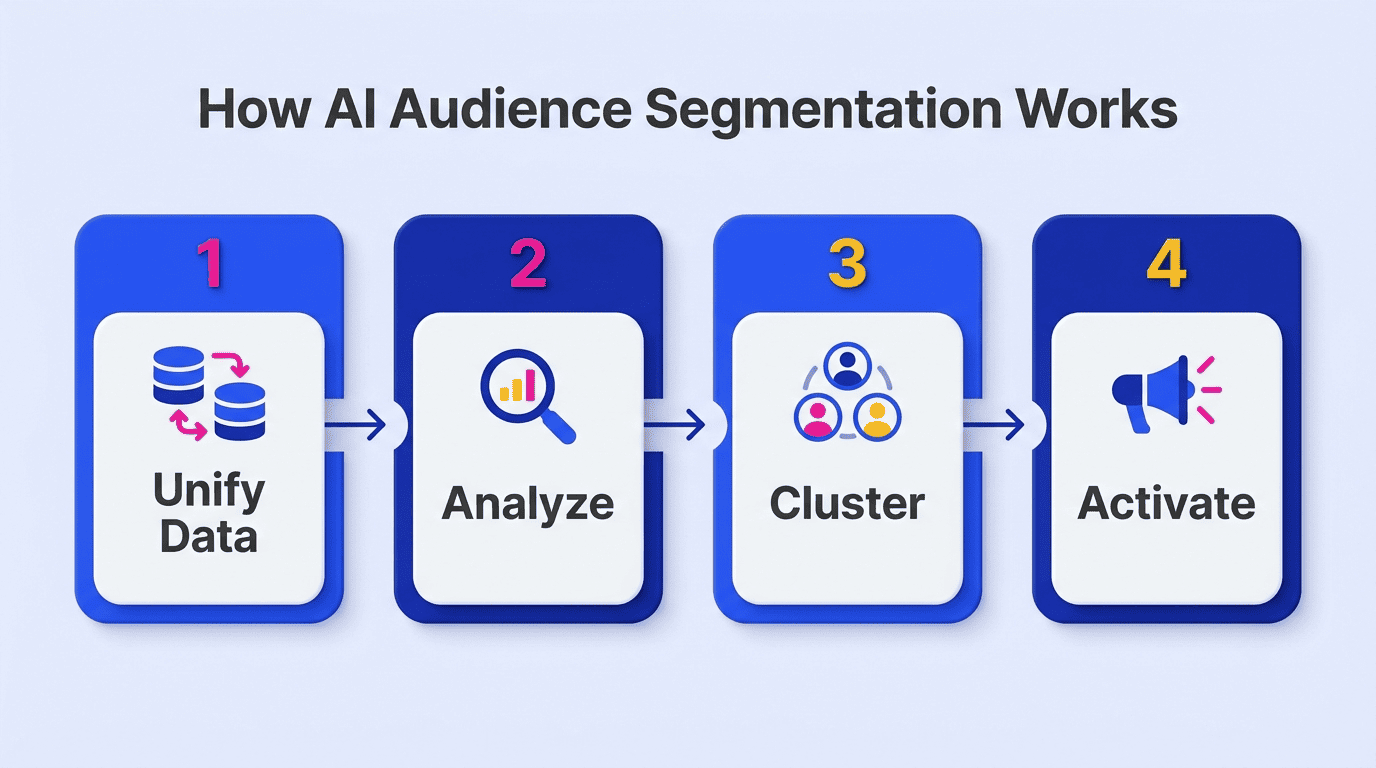
Step-by-step mechanism
- Unify first-party data from the CRM, website, email platform, and transaction history into a single customer data platform.
- Machine learning evaluates hundreds of variables — browsing behavior, purchase timing, engagement frequency — to find the strongest predictors of intent.
- The model clusters customers into segments based on those shared predictors, not fixed demographic buckets.
- Segments activate across email, ads, and other channels, then auto-update in real time as new behavioral data arrives.
Natural-language, no-code segment building
Modern platforms let marketers describe a segment in plain English — «high-intent shoppers who viewed pricing but didn’t buy» — and the AI translates that sentence into logic across every connected data source. No SQL query, no analyst queue, no waiting on the data team. This natural-language layer is what turned AI audience segmentation from a data-science project into something a campaign manager runs before lunch.
Traditional vs. AI Segmentation
The gap between rules-based segmentation and dynamic segmentation isn’t cosmetic — it changes how fresh a segment stays and how many patterns it can actually see.
Static rules vs. living segments
Traditional segmentation has an analyst write fixed rules — for example, «women aged 25-34 who purchased in the past 30 days» — and the segment is static from the moment it’s built; it decays as customers age out of the criteria or change behavior. AI segmentation instead produces dynamic segments that rebuild in real time and surface hidden patterns a human rule-writer would never think to test for.
| Traditional (rules-based) | AI-powered (dynamic) | |
|---|---|---|
| How it’s built | Analyst writes fixed criteria | Model learns from behavioral data |
| Freshness | Static, decays over time | Updates in real time |
| Variables considered | A handful, manually chosen | Hundreds, evaluated simultaneously |
| Discovers hidden patterns | No | Yes |
| Time to build | Days to weeks | Minutes |
The Types of Segments AI Creates
AI-powered audience segmentation doesn’t produce one kind of group — it layers several segmentation models on top of the same unified data, often running them simultaneously.
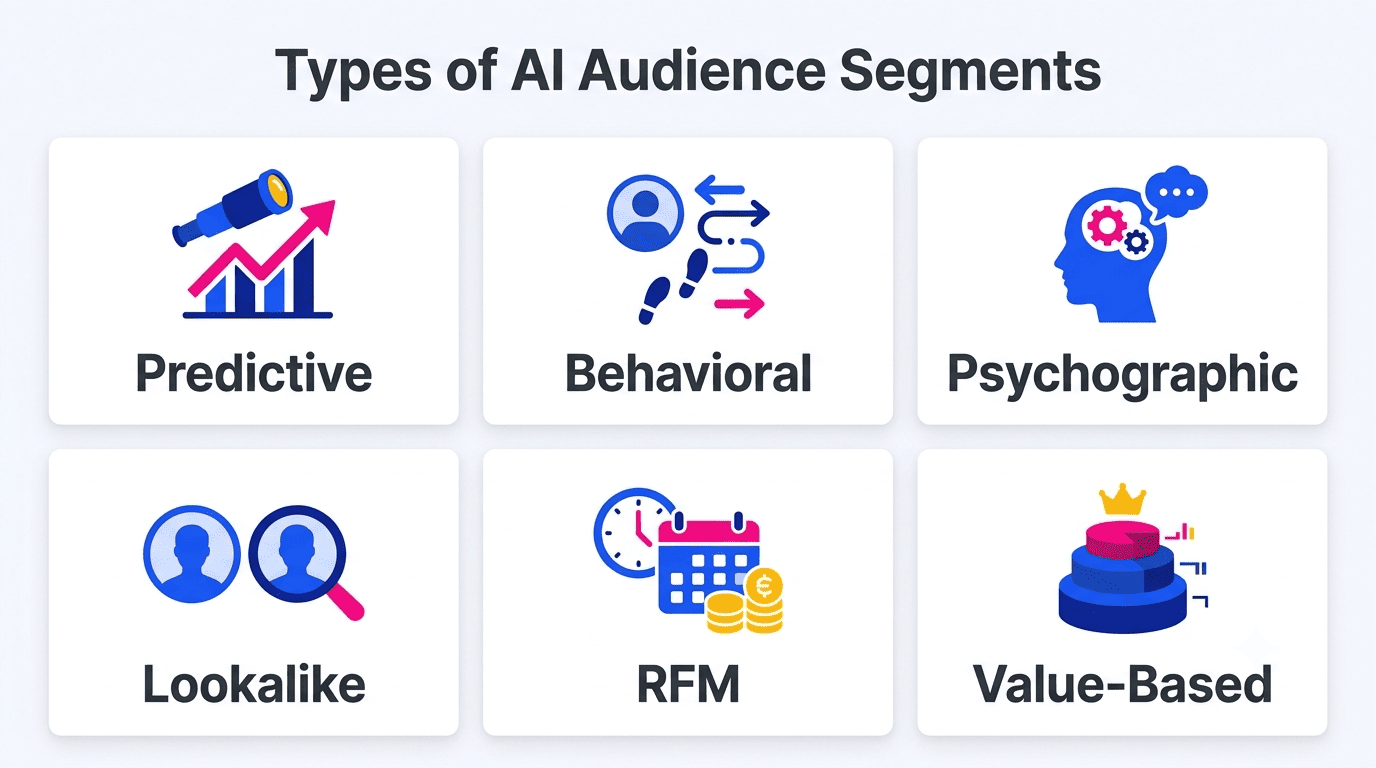
Predictive, behavioral, and psychographic segments
Predictive segmentation scores customers by their likelihood to convert, churn, or make a repeat purchase, ranking the entire base rather than sorting it into fixed tiers. Behavioral segmentation groups people by the actions they’ve actually taken — pages viewed, cart abandonment, email clicks. Psychographic segmentation infers attitudes and interests from behavioral signals rather than survey data. On top of these, AI can now auto-detect the six classic segmentation categories:
- Geographic — location, region, climate
- Demographic — age, income, life stage
- Behavioral — actions taken on-site and in-app
- Firmographic — company size and industry (B2B)
- Technographic — tech stack and tools used
- Psychographic — values, interests, lifestyle
Lookalike, RFM, and value-based segments
Each model pulls from the same unified profile but ranks customers on a different axis:
- Lookalike modeling — takes a seed audience of your best existing customers and finds new prospects who statistically resemble them, expanding acquisition targeting without new manual research.
- RFM segmentation — scores customers on recency, frequency, and monetary value of past purchases.
- Value-based segmentation — groups customers by predicted customer lifetime value, so budget and attention flow toward the highest-CLV cohorts instead of being spread evenly across the base.
The Benefits and ROI of AI Segmentation
The case for AI audience segmentation isn’t theoretical — vendors and their customers have published enough campaign data to make the pattern clear.
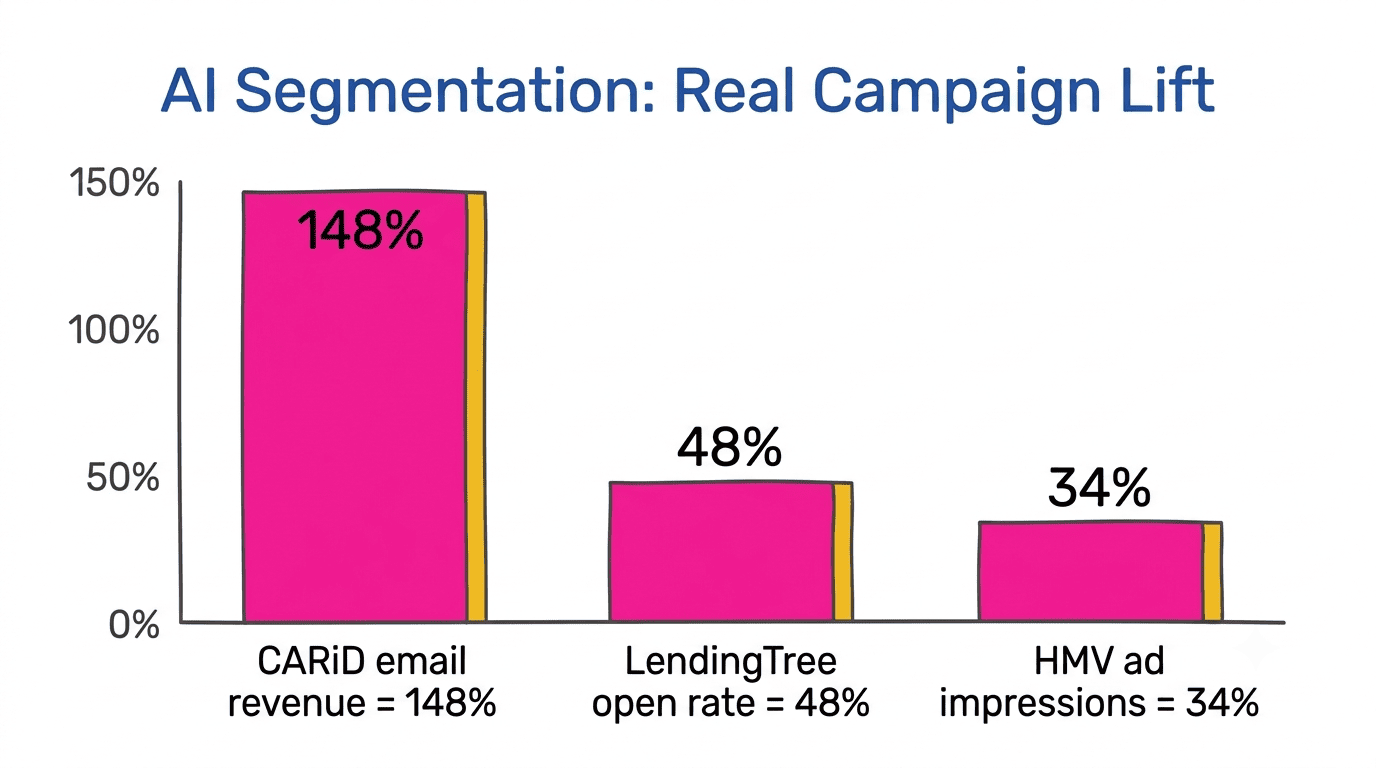
Higher lifetime value across the board. Case studies show AI-powered segmentation and personalization translate into channel-specific lift once the models are live: auto-parts retailer CARiD saw email revenue rise 148%, open rates rise 70%, and click-through rise 35% after switching to AI-based personalization and segmentation, per Blueshift’s published case study.
Engagement gains outside of email too. LendingTree recorded a 48% jump in email open rates after adopting dynamic segmentation, and HMV saw a 34% increase in Google Ads impressions on a newly built AI segment — evidence the lift isn’t confined to one channel.
Time saved on campaign building. Bloomreach customers report saving 1,720+ hours in aggregate using its prebuilt use cases, with some campaigns launched up to 70% faster. Adobe’s own internal team cut campaign turnaround from 10 weeks to 6 while running four promotional campaigns at once instead of two, after rebuilding its production workflow with automation — a shift in the entire cadence, not just a speed bump.
Measurable financial return. A Forrester Total Economic Impact study commissioned to evaluate Insider One’s platform found a 449% ROI and $10.2 million in incremental revenue over three years for the composite customer profiled.
| Case | Result | Metric type |
|---|---|---|
| CARiD | +148% email revenue, +70% open rate, +35% clicks | Engagement/revenue |
| LendingTree | +48% open rate | Engagement |
| HMV | +34% Google Ads impressions | Reach |
| Bloomreach customers | 1,720+ hours saved, up to 70% faster campaign launches | Efficiency |
| Adobe (internal) | 10-week → 6-week turnaround, 2 → 4 campaigns at once | Efficiency |
| Insider One (Forrester TEI) | 449% ROI, $10.2M revenue | ROI |
Best AI Marketing Automation Tools for Audience Segmentation
Picking a marketing automation platform for segmentation comes down to matching the tool’s data depth and integration count to your channel mix and budget.
Platform categories
- All-in-one MA + segmentation: HubSpot, ActiveCampaign, Klaviyo — bundle segmentation with email, CRM, and campaign execution in one login.
- Enterprise/CDP-grade: Salesforce Marketing Cloud (Einstein), Braze, Bloomreach, Blueshift — built for large contact volumes and dozens of integrations.
- Analytics-first: Amplitude, Audiense — lean toward deep behavioral analysis over out-of-the-box campaign execution.
ActiveCampaign uses machine learning to build predictive segments directly from CRM and email behavior, while Blueshift pairs real-time, no-code segment building with a broad library of pre-built integrations across CRM, ecommerce, and ad platforms. Insider One connects to over 100 data sources and destinations out of the box.
Pricing snapshot
Entry-level tools stay affordable: Omnisend’s Standard plan starts around $16/month, while Averi’s entry-level SOLO plan runs about $99/month. Audience-intelligence platforms like Audiense are largely quote-based rather than self-serve, and analytics-grade platforms such as Amplitude price their Growth tier on event volume with a custom quote rather than a flat monthly rate. Enterprise CDPs like Salesforce, Braze, and Bloomreach are typically custom-quoted based on data volume and contact count.
| Tool | Category | Starting price |
|---|---|---|
| Omnisend | All-in-one MA | ~$16/mo |
| Averi (SOLO) | AI segmentation | ~$99/mo |
| Audiense | Analytics-first | Custom/quote-based |
| Amplitude (Growth) | Analytics-first | Custom (event-based) |
| Salesforce / Braze / Bloomreach | Enterprise/CDP | Custom |
How to Implement AI Audience Segmentation
Rolling out AI-powered marketing automation platform segmentation is less about the algorithm and more about the data feeding it — most implementation failures trace back to skipped prep work, not model quality.
Consolidate first-party data before anything else. Every downstream segment is only as accurate as the CRM, website, and transaction data feeding the CDP, so this step comes before any model gets touched.
Pick segments tied to a real business goal. Acquisition, retention, and churn-prevention segments each pull on different variables — deciding the goal first keeps the model from optimizing for the wrong outcome.
Build with natural-language prompts, not spreadsheets. Describing the target audience in plain English lets the platform assemble the underlying logic across every connected data source in minutes.
Activate across every relevant channel at once. LiveRamp-scale activation can push a finished segment to 500+ destinations in a single click, so segments built once can run everywhere the audience actually is.
Let the model auto-update and test continuously. Dynamic segments should never be treated as «done» — A/B testing and automatic refresh are what keep a segment accurate months after launch.
Data Quality, Privacy, and Common Pitfalls
The most common failure mode in AI audience segmentation isn’t the algorithm — it’s what gets fed into it.
Garbage in, biased out
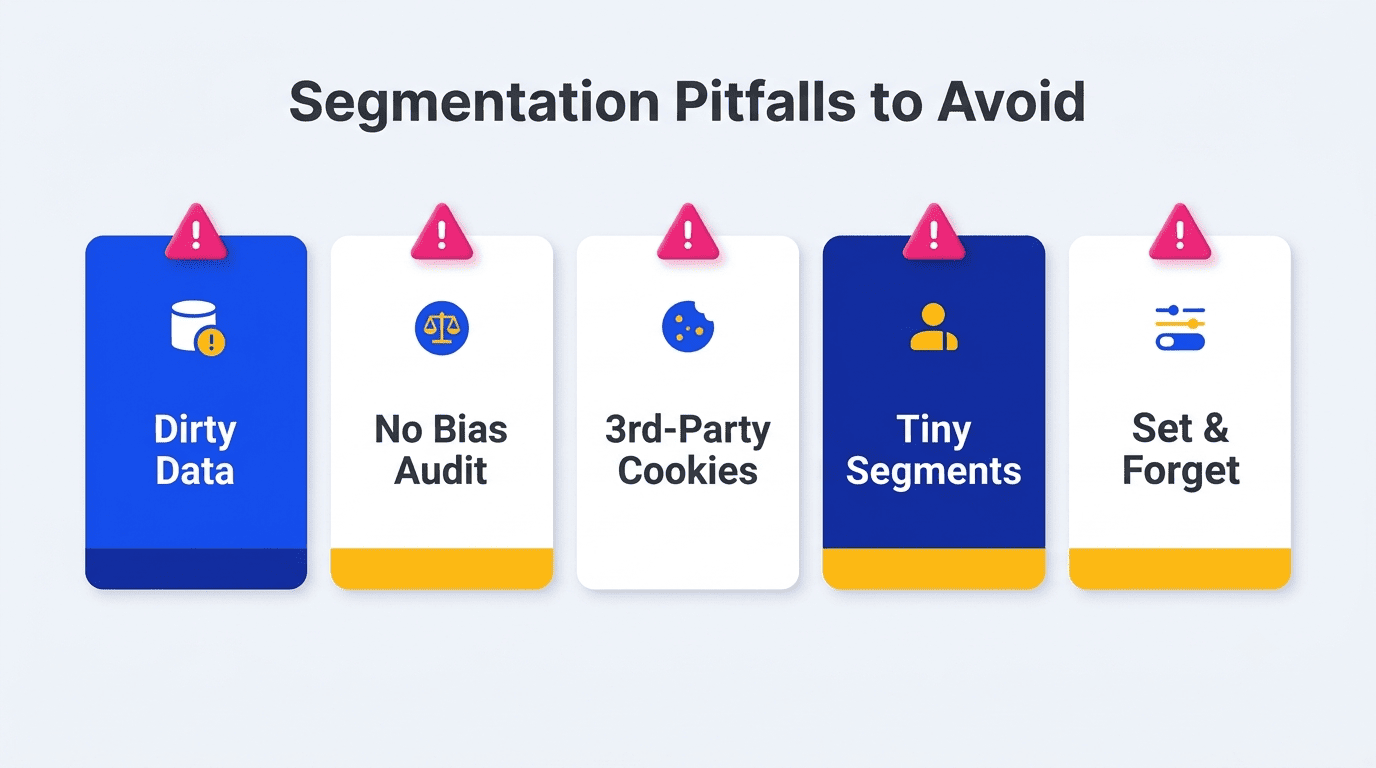
AI segments are only as good as the data behind them. Dirty, duplicated, or skewed first-party data produces algorithm bias: segments that misrepresent or systematically exclude entire groups of customers. Cleaning and deduplicating first-party data before segmenting is the single highest-leverage step in the whole process, and it’s the one teams most often skip under deadline pressure. Before scaling a segmentation program, check for the pitfalls that most often derail it:
- Feeding the model duplicate or stale customer records instead of a deduplicated, unified profile
- Skipping a bias audit on segments that touch protected categories like age, gender, or location
- Leaning on third-party data as first-party cookies phase out across major browsers
- Exposing very small segments (under roughly 1,000 users) that risk re-identifying individuals
- Treating a segment as «finished» instead of letting it auto-update and re-testing it periodically
Privacy and compliance
AI audience segmentation must honor the General Data Protection Regulation on consent and data use for any European customer data, and the California Consumer Privacy Act imposes similar obligations for California residents. Enterprise-grade tools typically layer on SOC 2 and HIPAA compliance for regulated industries. As the Federal Trade Commission has emphasized in its guidance to businesses, using clearly disclosed first-party data is both the more compliant and the more accurate path as third-party cookies continue to fade. Some platforms only expose a segment to marketers once it crosses a minimum size — 1,000 users, in one common implementation — specifically to prevent re-identification of individuals within small groups.
Personal data shall be processed lawfully, fairly and in a transparent manner in relation to the data subject.
General Data Protection Regulation, Article 5
An AI marketing automation platform that treats consent and data minimization as a design constraint — not an afterthought — is the one that keeps producing accurate segments as regulations tighten. Teams that bolt privacy on after launch tend to redo their entire data pipeline within a year, which erases most of the time savings AI segmentation was supposed to deliver.