AI Marketing Automation Examples and Use Cases: 7 Real Ways Brands Use It
Every vendor promises «AI-powered» marketing, but the useful question is what that actually looks like inside a real campaign. AI marketing automation shows up today as personalized email send-time optimization, lead scoring, 24/7 chatbots, generative ad and blog copy, churn prediction, micro-segmentation, and automated bid management.
The large majority of marketers now say they use AI in some part of their workflow — industry surveys have put the figure well above 60% and climbing year over year — and McKinsey research finds 71% of consumers expect personalized interactions from brands. This guide walks through seven use cases organized by task, then real brand examples with the results they reported, so you can see which pattern fits your own team before you try to copy an enterprise stack.

What Is AI Marketing Automation? (Quick Definition)
AI marketing automation is the automation of marketing workflows where a machine-learning model decides who gets contacted, what they see, and when — instead of a human writing a fixed if/then rule in advance. Traditional automation platforms fire the same email to everyone who abandons a cart on day three; an AI-driven marketing automation platform predicts which shoppers are actually likely to buy, times the message to each person’s own behavior pattern, and can generate the copy itself. Three things separate it from classic rule-based automation:
- Prediction — it scores the likelihood of an outcome (purchase, churn, click) instead of waiting for a trigger event.
- Generation — it produces the message itself (subject line, ad copy, product description) rather than filling a template.
- Real-time adjustment — it updates targeting and content as new behavioral data arrives, instead of waiting for a scheduled campaign refresh.
Gartner projects that agentic AI will be embedded in 33% of enterprise software by 2028, up from under 1% in 2024 — a sign this shift from static rules to adaptive decisions is still accelerating, not settling down.
7 AI Marketing Automation Use Cases (by Task)
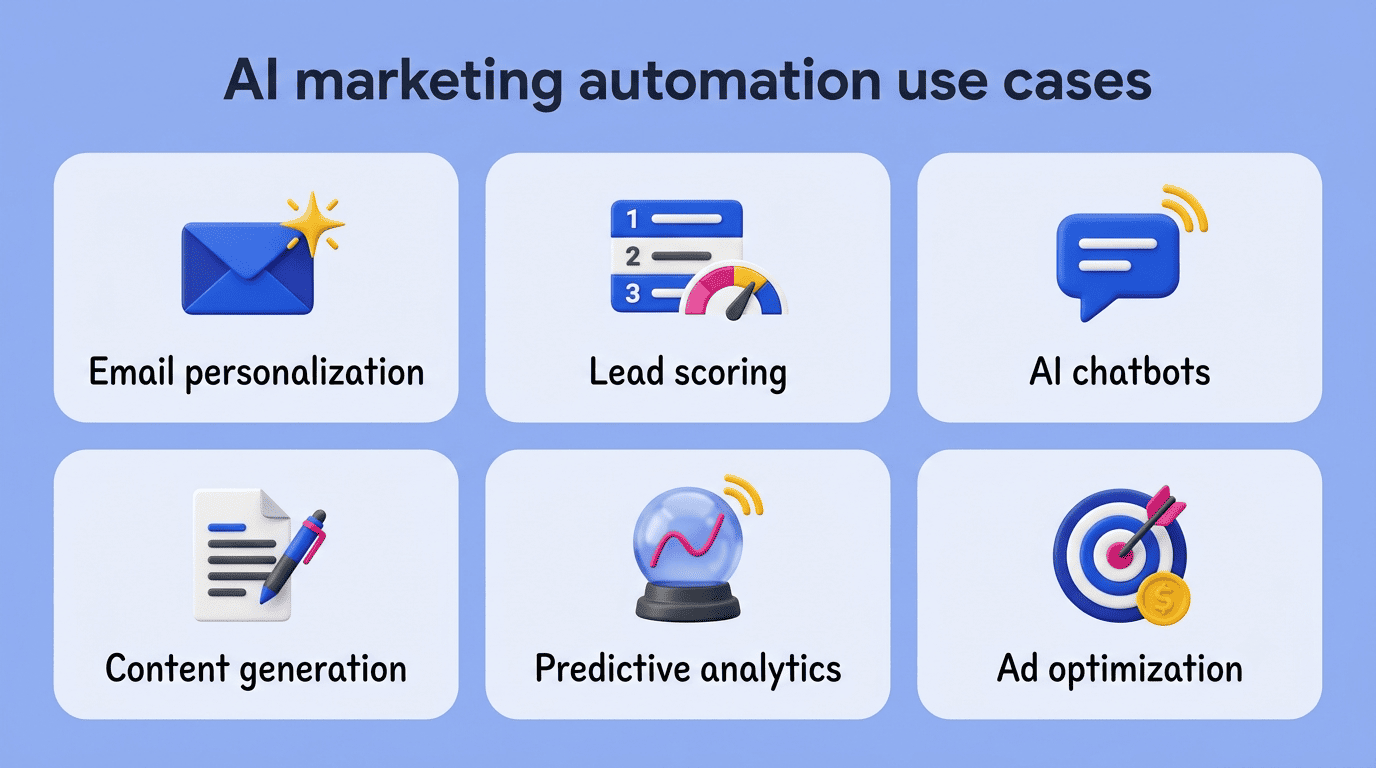
These seven patterns cover most of what companies mean when they say «we use AI in marketing.» Each one automates a specific decision a human used to make manually — and each has a well-documented brand example behind it.
1. Email personalization and send-time optimization
AI models read a subscriber’s browsing and purchase history, predict what they’re most likely to buy next, and pick the send time that historically gets that person to open. Amazon runs on this pattern at scale: its recommendation and abandoned-cart emails are generated per shopper, not per segment, pulling from the same engine that powers its «customers who bought this also bought» module on-site.
2. Lead scoring and qualification
Instead of a marketer assigning arbitrary point values to form fields, tools like Salesforce Einstein and HubSpot train a model on historical won and lost deals, then rank every new lead by real conversion probability. Sales reps work the list top-down and stop wasting calls on high-title, low-intent contacts that a manual scoring sheet would have flagged as «hot.»
3. AI chatbots and conversational engagement
Retail chatbots now do more than answer FAQs — they act as a standing-in stylist or product consultant. Sephora and H&M both deploy conversational bots that ask a shopper a few questions about preference and fit, then recommend specific SKUs, handling a volume of one-to-one conversations no human team could staff around the clock.
4. Content generation at scale
Generative tools cut first-draft time from hours to minutes. ChatGPT, Jasper, and similar models now produce first drafts of ad copy, email subject lines, blog posts, and product descriptions, which a human then edits and approves. The bottleneck shifts from «who writes this» to «who reviews this,» which is a materially different constraint for a lean marketing team.
5. Predictive analytics (churn, CLV, next-best-action)
Predictive models flag which customers are about to churn, estimate lifetime value, and suggest the next-best offer or touchpoint. Starbucks built its Deep Brew platform around exactly this: the system personalizes loyalty offers and menu suggestions per customer, and Starbucks has credited the broader personalization push, alongside Deep Brew, with helping grow its U.S. Rewards membership to roughly 17.6 million active members by the end of fiscal 2019, a period that also saw U.S. same-store sales rise about 6%.
6. Customer segmentation and micro-targeting
Machine-learning segmentation finds patterns no analyst would think to test. Platforms like HubSpot’s Breeze AI build behavioral micro-segments by time, device, and intent signal automatically, surfacing groupings — a specific hour-of-day and device combination that over-converts, for instance — that a human analyst would rarely think to test manually. Nike applies a similar approach across Nike Direct, using purchase and app-engagement data to segment members for its Nike+ loyalty ecosystem.
7. Ad targeting and budget optimization
AI shifts ad spend toward the placements and creatives performing best in near real time, instead of waiting for a weekly manual review. Spotify Ad Studio uses listening data to time and place audio ads against a listener’s actual habits, and programmatic bidding platforms broadly use the same real-time-optimization logic to move budget between channels automatically.
Here’s how those seven tasks map to the decision each one used to require a human to make:
| Use case | What AI decides | Old manual approach |
|---|---|---|
| Email personalization | Content, segment, send time per person | One blast to a static list |
| Lead scoring | Conversion probability per lead | Fixed point values per field |
| Chatbots | Response and product match, 24/7 | Human agents during business hours |
| Content generation | First-draft copy at volume | Writer drafts each piece manually |
| Predictive analytics | Churn risk, CLV, next-best-action | Quarterly cohort reports |
| Segmentation | Behavioral micro-segments | Demographic buckets |
| Ad optimization | Bid and placement in real time | Manual weekly budget review |
AI Marketing Automation Examples by Brand (with Results)
Numbers below are as reported by the companies or by the case-study sources cited — treat them as directional evidence of what’s possible, not a guarantee, since results vary by industry, data quality, and how long a program has been running.
Enterprise brand examples
Five names come up constantly in these examples, each automating a different slice of the marketing funnel:
- Amazon — automates email recommendations and cart-recovery messaging per shopper rather than per segment.
- Starbucks — its Deep Brew platform drives personalized loyalty offers, a program whose U.S. membership grew to roughly 17.6 million active members alongside a reported 6% rise in U.S. same-store sales, according to Starbucks’ fiscal 2019 results filed with the SEC.
- Nike — uses AI-driven segmentation across its Nike+ membership base to support Nike Direct, the company’s owned e-commerce and retail channel, within a company that reported roughly $51 billion in total annual revenue for fiscal 2024.
- Spotify — applies listening-behavior data to ad timing and placement through Ad Studio.
- Sephora and H&M — both run conversational bots that act as an automated product stylist.
Small-business and mid-market case studies
Marketing automation generates a 14.5% increase in sales productivity and a 12.2% reduction in marketing overhead.
Nucleus Research
Enterprise budgets aren’t a prerequisite. The case studies below all came from a single tool applied to one channel, not a full-stack enterprise rebuild:
| Business | AI tool used | Reported result |
|---|---|---|
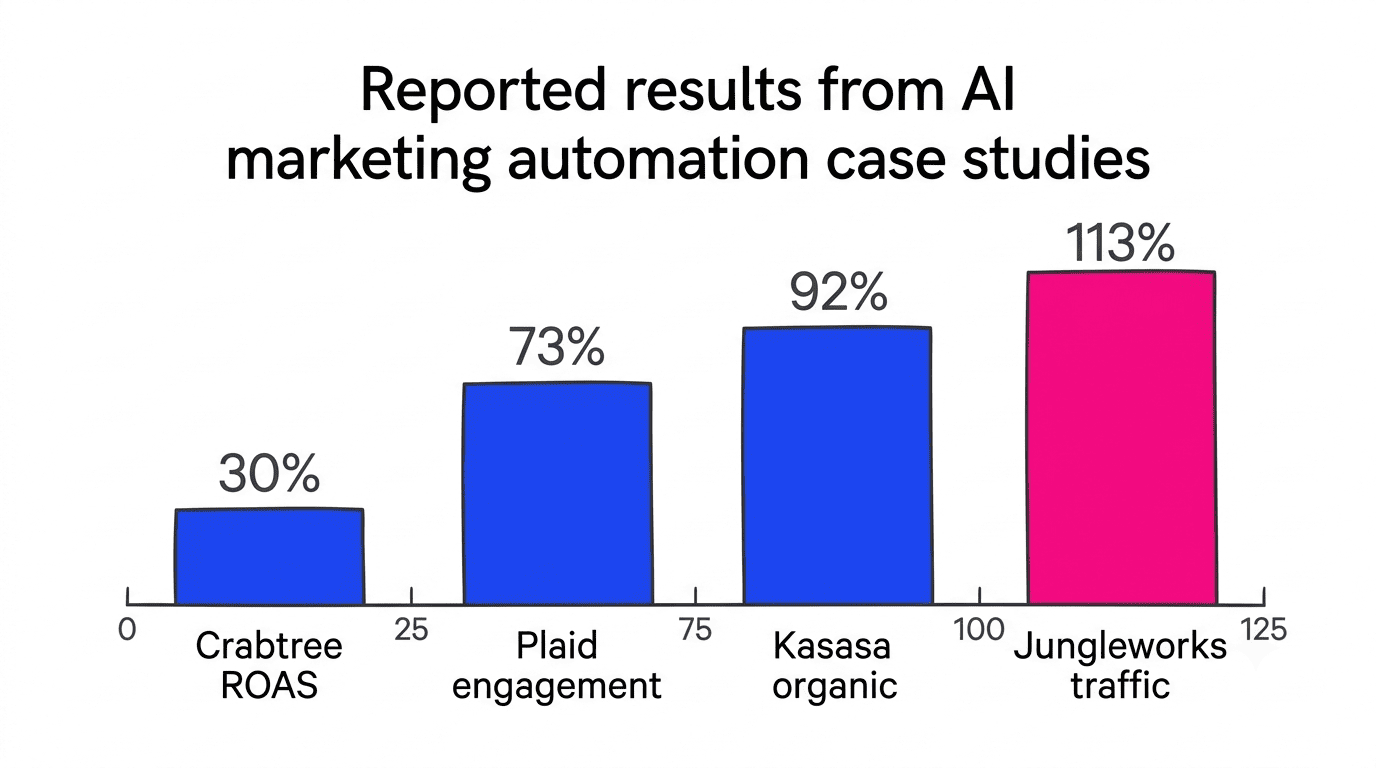
| Crabtree & Evelyn (skincare retailer) | Albert (ad platform) | 30% lift in return on ad spend in under 2 months |
| Plaid (fintech) | Sprout Social | 60% YoY LinkedIn follower growth, 73% higher engagement |
| Kasasa (community banking) | MarketMuse | 92% YoY increase in organic traffic |
| Jungleworks (ride-hailing) | Scalenut | 113% increase in website traffic, lower cost per lead |
One well-chosen AI marketing automation platform applied to a single, measurable use case is what all four have in common.
What Results Can You Expect?
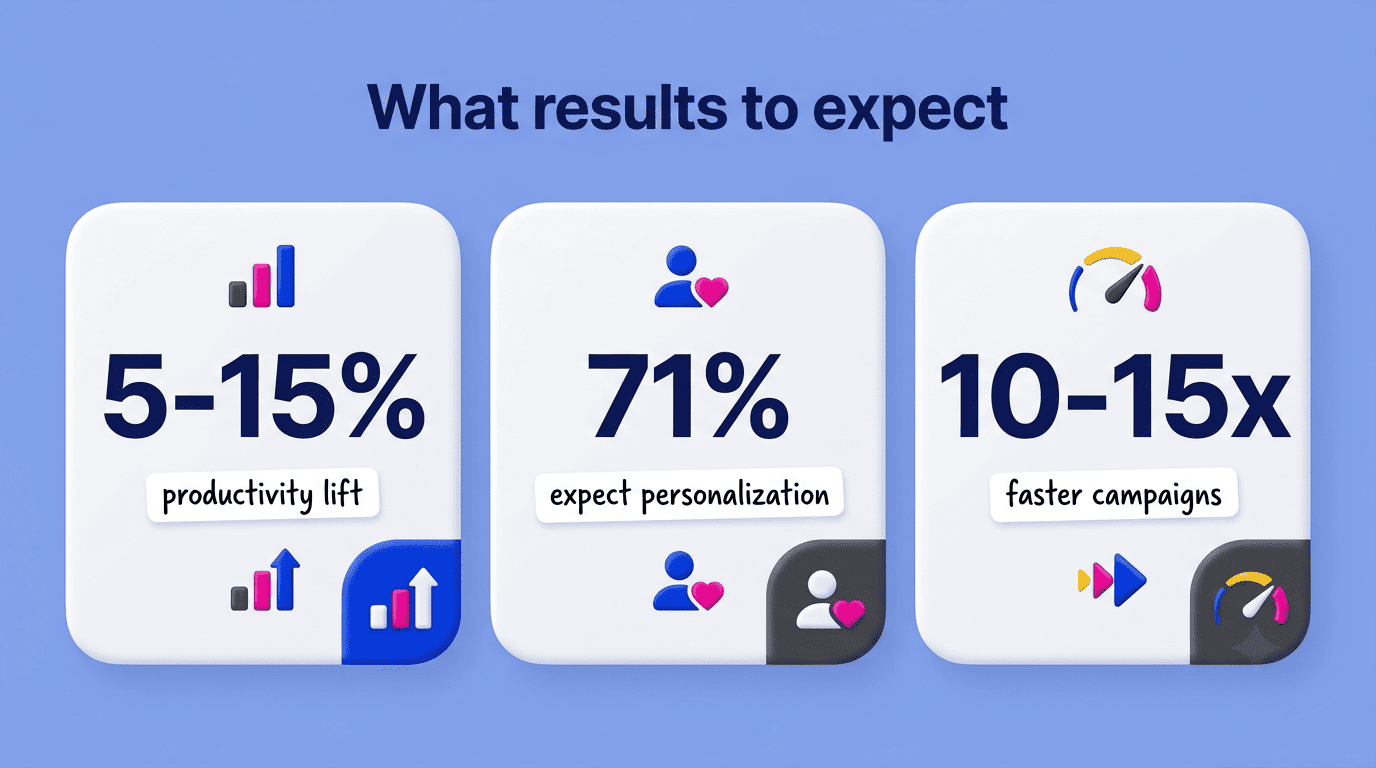
Aggregate research points in the same direction as the brand case studies, even though individual results differ. McKinsey estimates generative AI can lift marketing productivity by 5-15% of total spend, and its more recent research on agentic AI systems finds they can speed up the creation and execution of marketing campaigns by 10 to 15 times versus traditional workflows. On the customer side, 71% of consumers expect personalized interactions and 76% report frustration when a brand fails to deliver one, according to McKinsey’s consumer research. Separately, Salesforce has reported that 71% of marketers expect generative AI will help eliminate busy work and free them up for strategic tasks. None of this is a guarantee for any specific business — results depend heavily on data quality, the use case chosen, and how long the program has been running before someone measures it.
Tools Behind These Examples
Most of the examples above run on a small handful of platform categories, not on bespoke in-house AI. Here’s roughly how the tooling breaks down by task:
- CRM-native scoring and journeys — HubSpot’s Breeze AI and Salesforce Einstein handle lead scoring, segmentation, and journey orchestration.
- Email and lifecycle marketing — Klaviyo and Mailchimp apply AI to send-time optimization and behavioral triggers.
- Content generation — Jasper and ChatGPT draft ad copy, emails, and blog posts at volume.
- Social media management — Sprout Social, the platform behind the Plaid case study, applies AI to publishing schedules and engagement analysis.
- Ad and SEO optimization — Albert (advertising) and Scalenut or MarketMuse (organic content and SEO) power the budget- and traffic-focused case studies above.
This is a survey of what each category does, not a buying guide — pricing and depth vary widely within each one, and the right pick depends on which single use case you’re solving for first.
How to Apply These Use Cases in Your Business
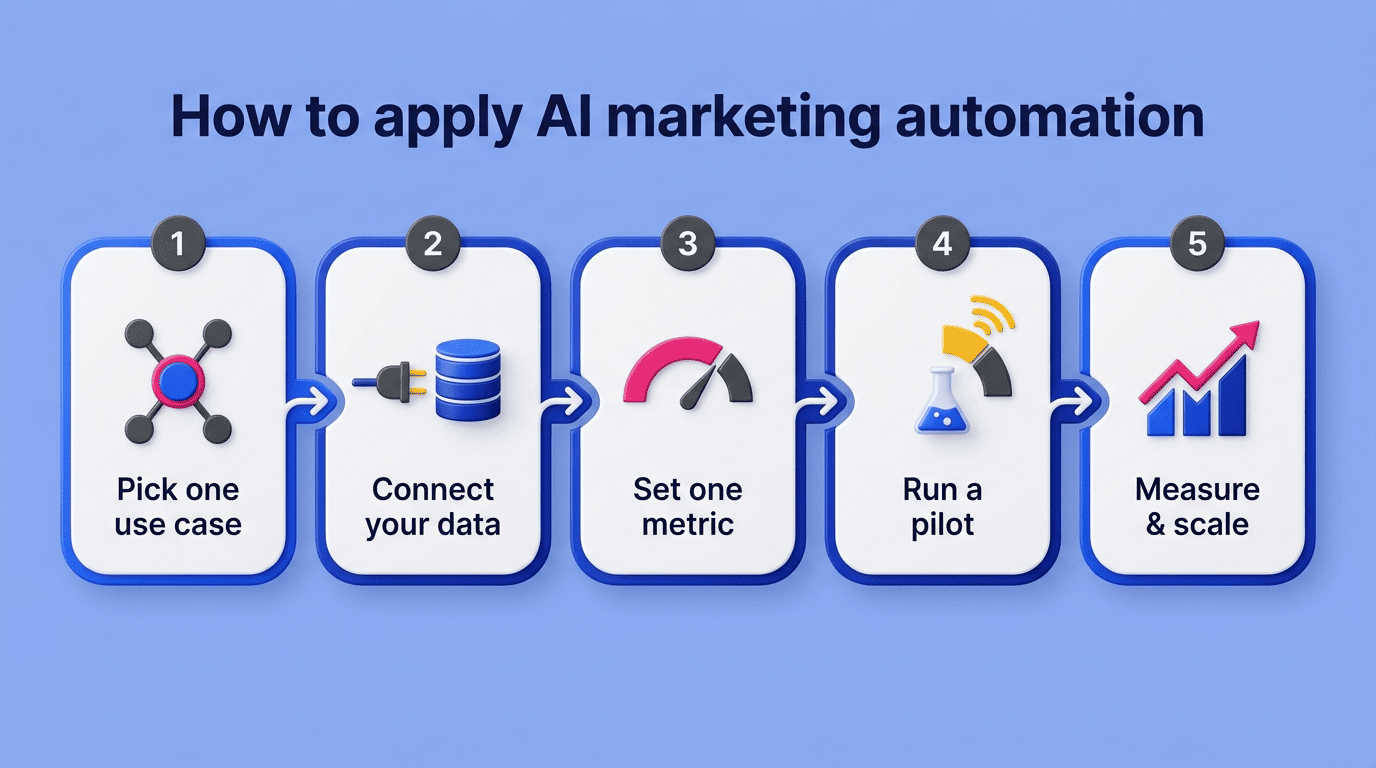
Trying to replicate an enterprise-scale rollout in one step is the most common way these projects stall. A narrower, sequenced approach gets to a measurable result faster:
- Pick the single use case with the fastest visible payoff — for most teams that’s email personalization or a support chatbot, since both connect to data you likely already have.
- Connect the data source — plug the tool into your CRM, email platform, or product analytics; an AI system is only as good as the behavioral data it can see.
- Define one success metric before launch — ROAS, open rate, or leads-per-week, matching the metric each case study above actually reported.
- Run a pilot on a limited segment or budget — mirror the Crabtree & Evelyn approach of testing before committing full spend.
- Measure against your baseline at a fixed interval — 30 to 60 days is typical, long enough for the model to have real behavioral data to learn from.
- Scale only what worked, then add the next use case — treat the seven use cases above as a sequence, not a simultaneous rollout.
Businesses that try to adopt every use case at once tend to under-resource each one; the case studies with the clearest reported results all started from a single, well-measured pilot.