
AI Marketing Automation for Lead Scoring: How It Works and How to Set It Up
A well-configured AI marketing automation platform scores leads by letting a machine-learning model rank prospects on their real likelihood to convert — instead of adding up static points a marketer guessed at. That shift matters because guesswork scoring rewards the wrong signals, and sales teams end up chasing titles instead of buyers.
The model learns from your historical won/lost deals plus behavioral, intent, and firmographic signals, a method peer-reviewed research on B2B lead prioritization confirms outperforms manual rules. It updates itself automatically and pushes a live score into your CRM so sales works the hottest leads first, without a marketer manually re-weighting a spreadsheet every quarter.

What Is AI Lead Scoring?
AI lead scoring is a machine-learning ranking of prospects by their probability of converting, built from historical patterns, on-site behavior, and third-party intent signals. Instead of a human deciding that a job title is worth five points, the model finds correlations a person would never spot — for example, that a visitor who hits the pricing page before the product overview converts roughly 40% more often than one who follows the reverse path.
Most platforms express AI lead scoring as a single number between 0 and 100. Demandbase, for instance, flags scores of roughly 90-95+ as needing immediate sales attention and treats scores around 50+ as worth focused follow-up — it’s account-level scoring rather than individual-lead scoring, but the pattern holds. The exact thresholds and unit of scoring vary by vendor, but a live, recalculated score instead of a fixed point total is consistent across tools.
Adoption has moved fast. AI adoption across go-to-market teams has climbed sharply over the past two years, and a growing share of marketers now apply it specifically to lead scoring. The jump reflects a simple operational win: automation removes the recurring chore of manually re-scoring rules every time the market or the product shifts.
Predictive lead scoring and AI-based lead qualification are effectively the same idea described from two angles — one emphasizes the forecasting math, the other emphasizes the sales-readiness outcome. Both rely on the same underlying machine learning layer to do the ranking.
How AI Lead Scoring Works
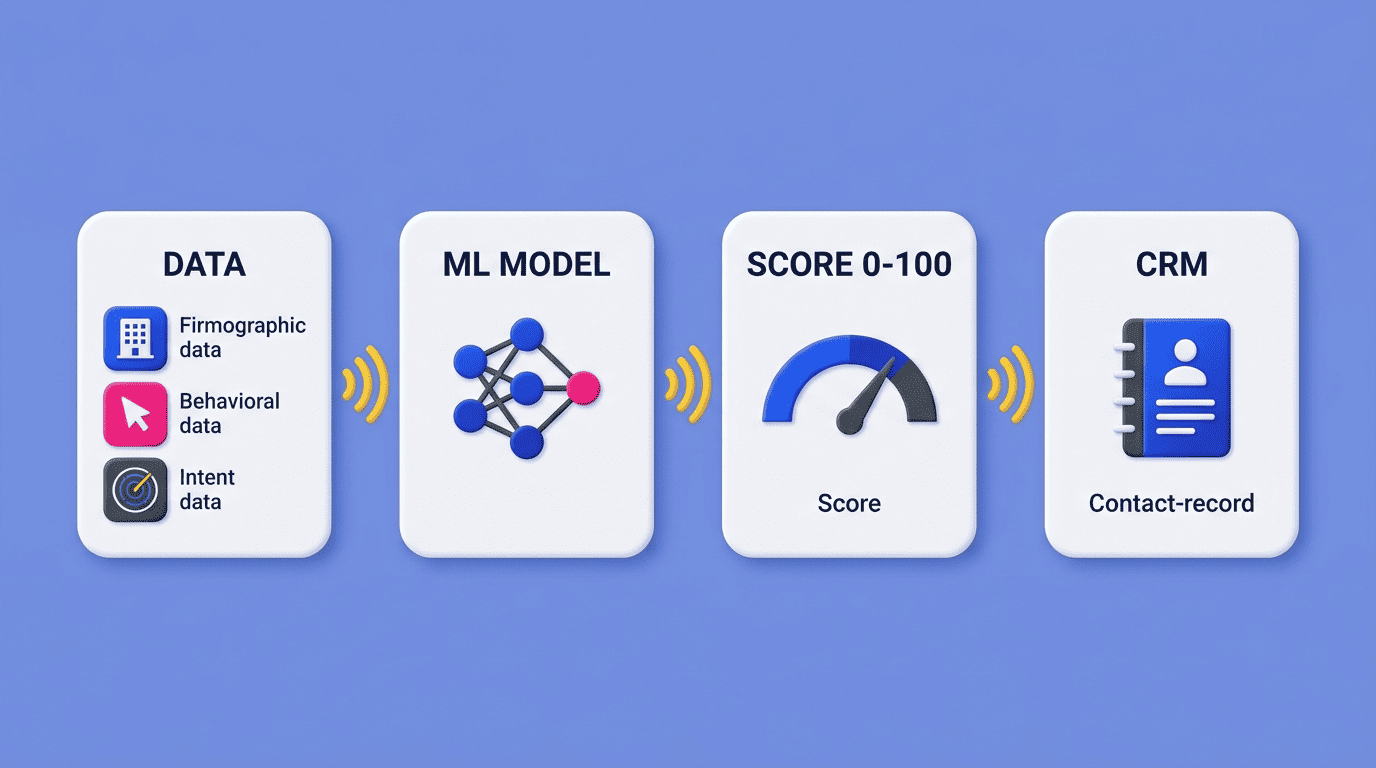
An AI lead-scoring model is built in three data layers, then trained against real outcomes. Getting this pipeline right matters more than picking a specific algorithm, since a model trained on thin or biased data will misrank leads no matter how sophisticated the math is underneath it.
Data the Model Learns From
A scoring model draws on three distinct data layers, plus one foundational dataset that ties them together:
- Fit / firmographic data — company size, industry, revenue band, and the prospect’s job function.
- Behavioral / engagement data — site visits, email opens, form fills, content downloads.
- Intent data — typically sourced from third parties, flags buying signals that happen off your own website, before a prospect ever lands on your domain.
- Historical won/lost data — the record of which past leads actually closed and which stalled; this is the foundation the model trains against.
Training and Live Scoring
Machine-learning algorithms — Random Forest, Gradient Boosting, and Logistic Regression are the most common choices — sift through that combined dataset to identify which features actually predict a closed deal, rather than which ones a marketer assumed mattered. A 2025 study published in Frontiers in Artificial Intelligence found this class of model consistently outperformed traditional, rules-based lead-scoring methods.
Once trained, the model keeps updating itself as new outcomes come in. Salesforce Einstein, for instance, retrains its underlying predictive model roughly every ten days. Deployment speed is also notable: an AI marketing automation platform can typically get a working scoring model live in days rather than the weeks of manual calibration earlier rules-based systems required.
AI vs Traditional Rules-Based Scoring
| Dimension | Traditional Rules-Based Scoring | AI Lead Scoring |
|---|---|---|
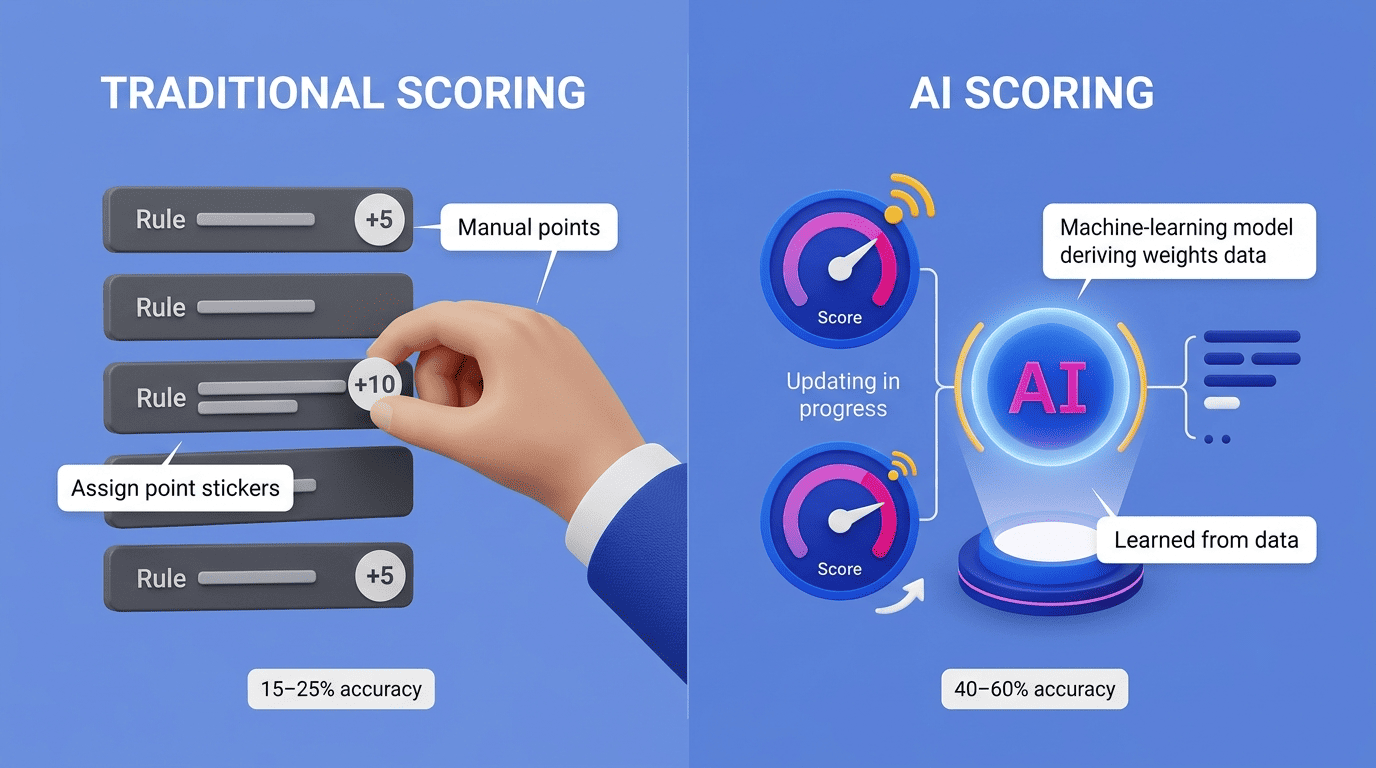
| How weights are set | Marketer manually assigns points (e.g., 5 for job title, 10 for form fill) | Model learns weights from historical outcome data |
| Adaptability | Static until someone manually revises it | Continuously updates as new won/lost data arrives |
| Typical accuracy | 15-25% | 40-60% |
| Negative signals | Rarely modeled | Built in (penalizes anti-fit behavior) |
| Setup effort | Ongoing manual maintenance | Upfront data prep, then largely automated |
Ruled by Guesswork vs Ruled by Data
Under a traditional model, a marketer decides a senior title is worth five points and a demo-request form is worth ten — a judgment call that’s subjective on day one and stale by the next quarter. AI lead scoring instead lets the model derive those weights directly from what actually correlated with closed revenue. Industry benchmarks commonly put that difference at roughly 15-25% accuracy for manual scoring versus 40-60% for AI-driven scoring — a rough two-to-three-times improvement at flagging leads that genuinely convert, though exact figures vary by vendor and dataset.
The Cost of Getting It Wrong
Poor qualification isn’t a rounding error. MarketingSherpa’s oft-cited case study on lead scoring found that roughly 73% of B2B leads aren’t yet sales-ready when they’re handed off, and a properly scored, prioritized pipeline lifted converted leads by 79% for the company it studied. Every lead a rules-based system misclassifies as hot pulls a sales rep’s attention away from one that actually would have closed, which compounds across a pipeline of any real size.
Benefits and Results
The return on AI-driven scoring shows up in both revenue and cost lines, and the gap between scored and unscored pipelines is wide enough that most B2B teams treat it as a baseline expectation rather than an experiment.
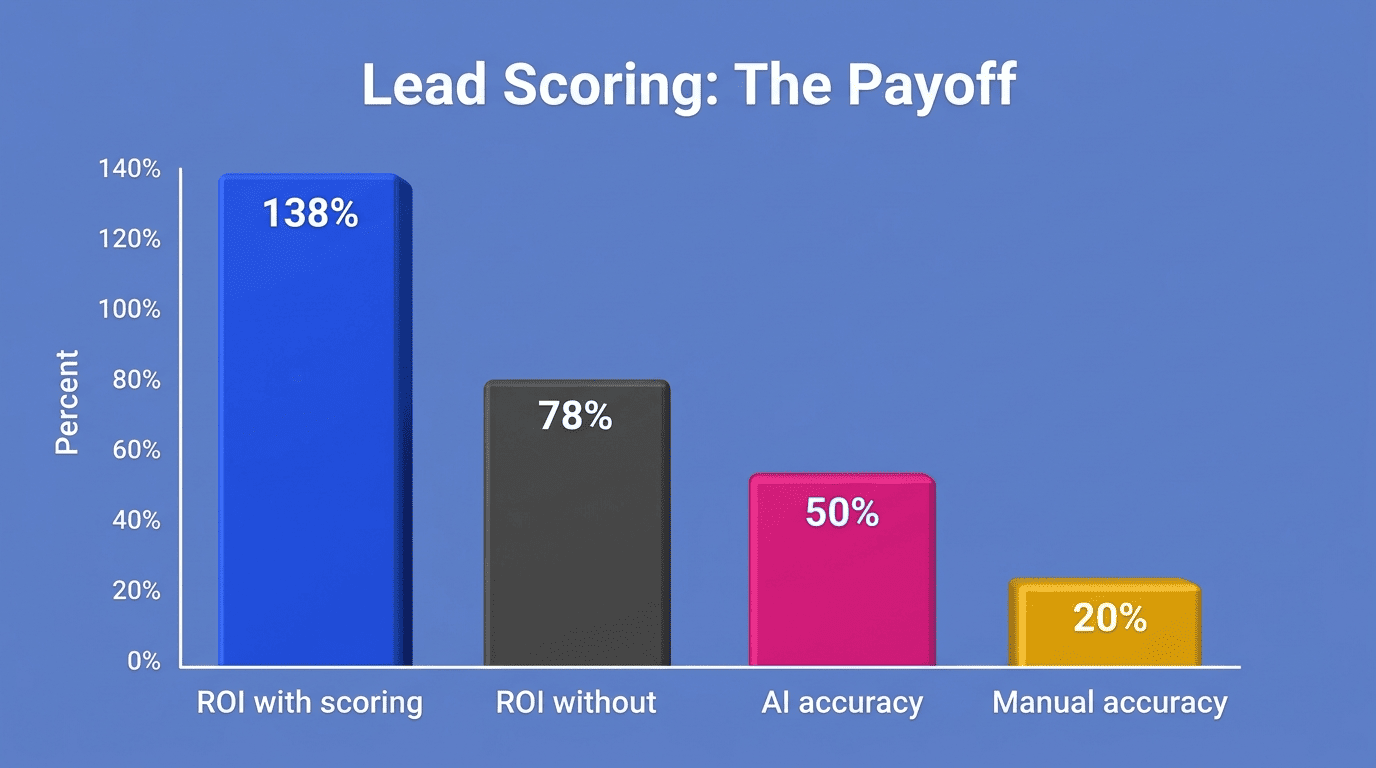
Companies using lead scoring report a 138% average ROI, compared with 78% for those that don’t (MarketingSherpa). On the cost side, the qualification cost per lead tends to fall 60-80%, and the time sales spends qualifying drops 30-40% — hours that get redirected to actually selling.
Two vendor case studies illustrate the range:
- Workforce Software — a 121% increase in in-market account engagement within six months of deploying Demandbase’s AI-driven account scoring.
- DocuSign — reportedly a 22x return on its scoring investment alongside a 38% lift in sales-qualified leads, per vendor-reported figures.
Results vary by industry and data quality, but the direction is consistent.
Speed compounds these gains. The average lead response time across B2B sales teams is roughly 42 hours — nearly two days (Harvard Business Review). Responding within five minutes instead is about 21 times more effective at qualifying that lead (MIT/InsideSales Lead Response Management study), and 6sense’s B2B Buyer Experience research found 84% of buyers say the first vendor they engaged with ultimately won the business. AI scoring surfaces the hottest leads instantly, which is what makes a five-minute response operationally possible instead of aspirational.
The developed model significantly improved the company’s ability to identify high quality leads compared to the traditional methods used.
González-Flores, Rubiano-Moreno & Sosa-Gómez, Frontiers in Artificial Intelligence
Key Concepts: Fit, Engagement, Score Decay, and Intent
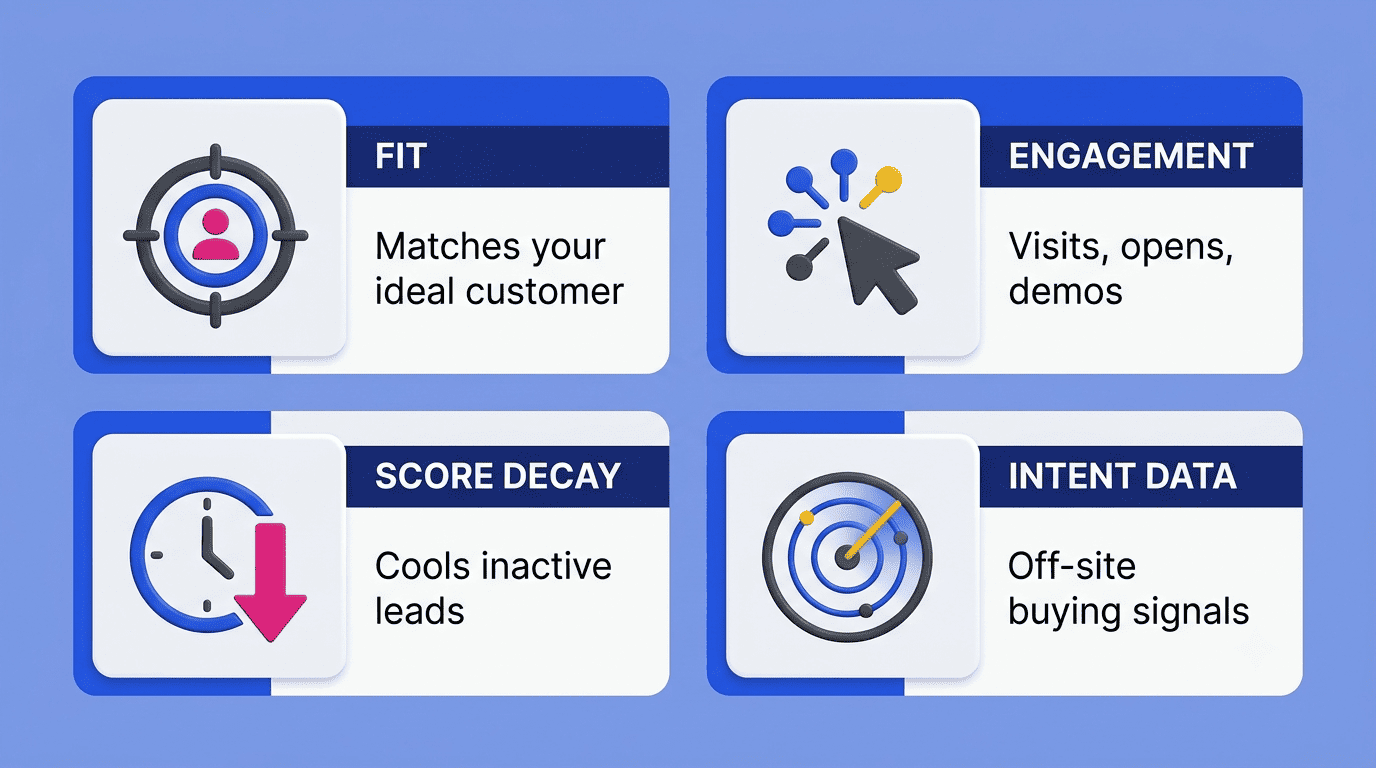
A working AI lead-scoring system leans on four interlocking concepts, and understanding how they combine explains why a single «score» can mean very different things depending on which inputs dominate it.
Fit and Engagement Are Not the Same Signal
Fit scoring measures how closely a prospect’s company matches your Ideal Customer Profile — industry, headcount, revenue band, and the individual’s role within the org. Engagement scoring measures what that prospect is actually doing: page visits, email opens, demo requests. A well-fit prospect with zero engagement isn’t ready; a highly engaged prospect who’s a poor fit rarely closes. AI models combine both, and most also apply negative points for anti-signals — a competitor domain, an unsubscribe, a job title that signals no purchasing authority.
Score Decay and Intent Data
Score decay automatically lowers a lead’s score over time if engagement stalls, so a prospect who went quiet three months ago doesn’t keep sitting in the «hot» queue alongside leads who engaged this week. Intent data adds a separate layer: third-party signals that flag buying research happening off your own site, often before that prospect ever visits your domain directly. Because B2B purchase decisions typically involve a buying group of roughly 6 to 10 stakeholders (Gartner), many platforms now score at the account level rather than just the individual lead level, aggregating signals across everyone touching the deal.
AI Lead Scoring Tools and Platforms
Vendor choice generally comes down to which CRM you already run, how much historical data you have to train on, and budget — enterprise intent platforms and SMB-friendly tools sit at very different price points for good reason.
| Platform | Approximate Pricing | Notable Detail |
|---|---|---|
| HubSpot | Marketing Hub Professional from $800/mo (3 seats, +$45/seat), Enterprise from $3,600/mo (5 seats, +$75/seat) | Requires premium Marketing Hub tier; predictive + fit/engagement scoring |
| Salesforce Einstein | $165-500/user/mo depending on Sales Cloud edition | Retrains roughly every 10 days |
| 6sense | $35,000-100,000+/yr, enterprise deals often higher | Known for «dark funnel» intent detection |
| MadKudu (acquired by HG Insights, 2025) | Historically ~$2,000+/mo; no longer sold as a standalone product | Focused on product-qualified and sales-qualified lead scoring |
| ActiveCampaign | $15-145/mo | Budget-friendly entry point for smaller teams |
How to Choose Among Them
Prioritize native integration with the CRM you already run. A scoring platform that requires custom middleware to sync with your existing marketing automation stack adds latency and breakage risk that erodes the accuracy gains you’re paying for.
Check the data floor before committing. Predictive scoring models need a minimum volume of historical won/lost data to be reliable — HubSpot’s AI-generated lead score, for instance, requires at least 50 contacts with a roughly even split of converted and non-converted outcomes, while older predictive-scoring implementations typically want several hundred closed contacts for stable results. Confirm the specific vendor’s threshold against your actual pipeline volume before you buy.
Weigh model transparency against black-box convenience. Some platforms expose which features drive a score; others don’t. Sales teams tend to trust and act on scores faster when they can see the reasoning behind them.
Compare per-seat pricing against flat enterprise contracts. Tools like HubSpot and ActiveCampaign price per seat, while platforms like 6sense sell annual contracts that can run into six figures — the right model depends on team size and how concentrated your buying committee is.
How to Implement AI Lead Scoring (Step by Step)
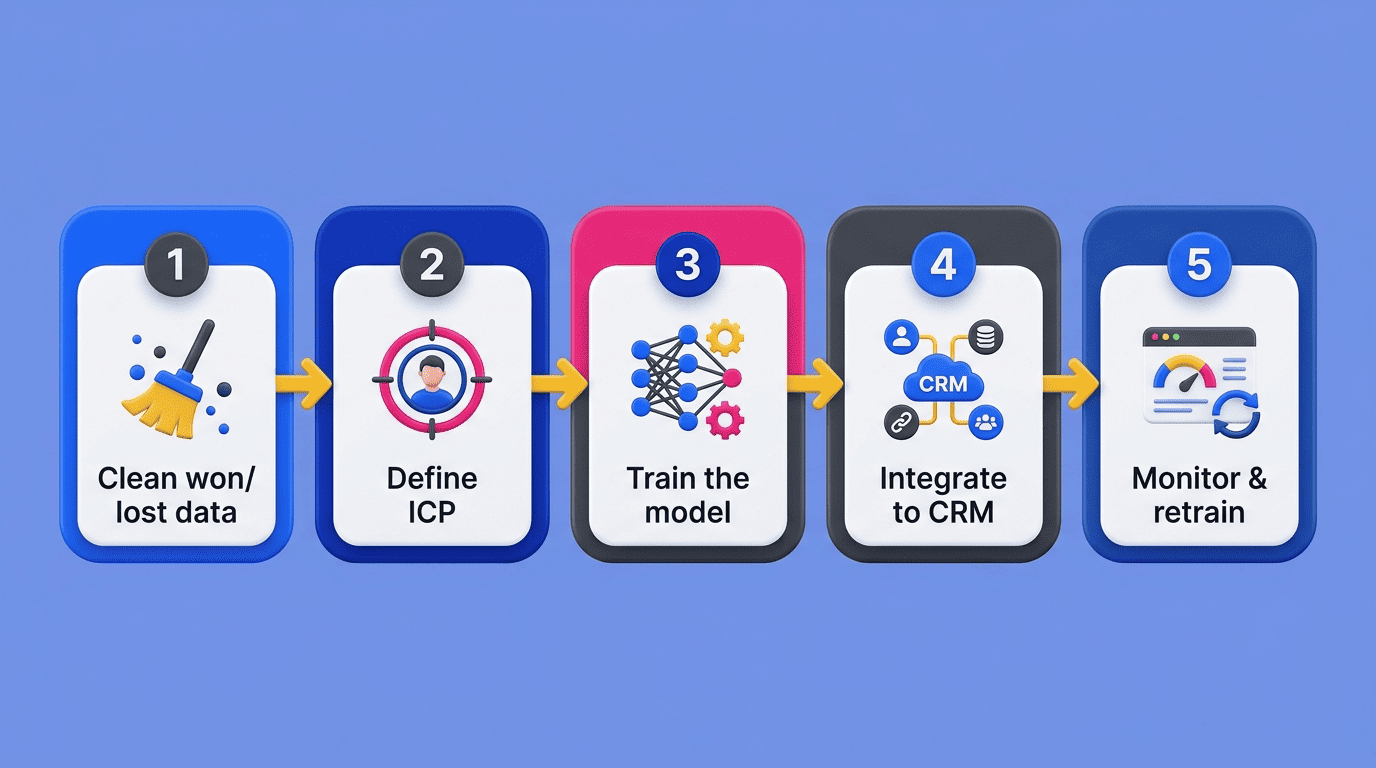
- Collect and clean your historical won/lost data. This dataset is the foundation the model trains on, so duplicate records and missing outcomes will directly degrade scoring accuracy.
- Define your Ideal Customer Profile and target outcomes. Be explicit about what «converted» means for your business — a closed deal, an SQL handoff, a demo booked.
- Train or configure the model on your chosen platform. Most AI marketing automation platforms handle the algorithm selection internally; your job is feeding clean, labeled data.
- Integrate the live score into your CRM and sales routing. A score that sits in a dashboard nobody checks delivers none of the speed advantage described earlier.
- Monitor performance and let the model retrain. Revisit accuracy monthly and confirm the model is still learning from fresh won/lost outcomes, not a stale training set.
Keep the tools-versus-people balance in mind through the rollout: the algorithm and technology stack matter, but analytics veterans like Avinash Kaushik have long argued that skilled people and process, not the tooling itself, do most of the work in making a data-driven system pay off. Teams that treat AI lead scoring as a plug-and-play tool, without adjusting sales workflows to actually act on the scores, tend to underperform the benchmarks above.
Data, Integration, and Compliance
A scoring model is only as reliable as the data feeding it, and the data itself carries legal obligations that are easy to overlook once the technical setup is running.
Clean Data and Integration
Duplicate contact records and stale engagement signals distort a score just as badly as bad training data does, so data hygiene is an ongoing task, not a one-time cleanup before launch. AI lead scoring also depends on seamless integration between your CRM and marketing automation stack — Salesforce, HubSpot, and Marketo are the most common pairings — since the score is only useful if it reaches the people making outreach decisions in real time.
Compliance Isn’t Optional
Because scoring pulls together personal and third-party intent data, it falls squarely under privacy regulation:
- CCPA — in the United States, the California Consumer Privacy Act governs how prospect data can be collected and used.
- GDPR — in markets with EU exposure, GDPR sets consent, transparency, and opt-out requirements.
- SOC 2 — enterprise-grade platforms like ZoomInfo carry SOC 2 certification specifically to reassure buyers that intent and firmographic data is handled to an auditable standard.