
AI Marketing Automation: How It Works, Use Cases, and Tools
AI marketing automation uses machine learning to run and optimize marketing tasks — segmentation, lead scoring, nurturing, email, and personalization — with far less manual work. According to Wikipedia’s overview of marketing automation, the category originally referred to software that executes repetitive tasks on a schedule; the AI-powered version goes further by learning from data and deciding the next best action in real time, rather than just following a fixed script.
Unlike traditional if/then automation, AI-powered systems predict, personalize, and adapt continuously — turning raw customer data into automated decisions across the whole customer journey, from the first ad click to the renewal email eighteen months later.

What Is AI Marketing Automation?
AI-powered marketing automation is marketing automation enhanced with machine learning, predictive analytics, and natural language processing that learns from behavior and data instead of following only fixed rules. As IBM’s overview of marketing automation frames it, the technology exists to help teams manage campaigns and customer interactions across multiple channels without manual, repetitive effort — AI simply adds a layer of judgment on top of that execution engine.
Definition and how it differs from rule-based automation
Rule-based tools do “if X then Y”: if a visitor opens an email, then send a follow-up three days later. That logic is rigid — it treats every recipient the same way regardless of how they actually behave. AI marketing automation software instead scores each contact, predicts what they are likely to do next, and decides the best action per person in real time. The difference is not cosmetic; it changes who gets which message, when, and through which channel.
The core technologies: ML, predictive analytics, NLP
Machine learning finds patterns across thousands of past interactions — clicks, purchases, time-on-page — that a human analyst would never spot manually. Predictive analytics turns those patterns into forecasts: who is likely to convert this week, who is at risk of churning, who will open an email at 7 a.m. versus 9 p.m. Natural language processing powers content generation and chatbots, letting systems draft subject lines, summarize customer intent, and hold a real-time conversation. None of this works without a fourth, less glamorous layer underneath: data aggregation and unification, which pulls CRM, web, email, and ad data into one place so the models have something reliable to learn from.
How AI Marketing Automation Works
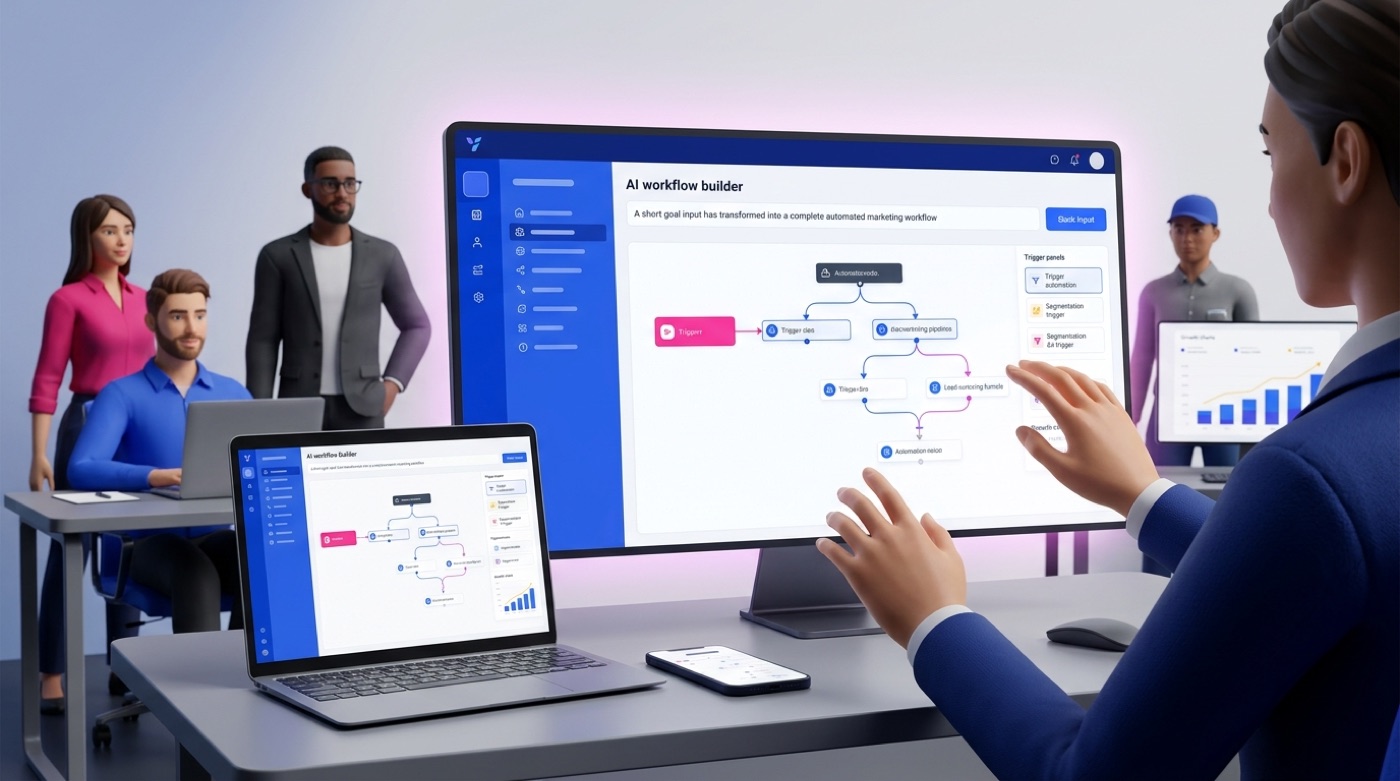
At a mechanical level, AI-driven marketing automation runs on a loop rather than a one-time setup. The system does not just fire a campaign and stop — it watches the results and adjusts the next cycle based on what happened.
The core loop: data, analysis, action, learning
- Aggregate and unify data from CRM, website, email, and ad platforms into a single customer record.
- AI analyzes the data to build dynamic segments and predict behavior — who is ready to buy, who is going quiet.
- The system executes an automated action, such as sending a personalized email, adjusting an ad bid, or triggering a chatbot conversation.
- Results feed back into the model, which continuously learns and optimizes the next round of decisions.
Marketers still review performance dashboards between cycles and adjust goals, budgets, or messaging guardrails — the loop is automated, but oversight is not removed from it.
Data readiness matters
Clean, connected data is the prerequisite for any of this to work — poor data quality is consistently the top reason AI marketing automations underperform or get abandoned after a pilot. Before turning on an AI workflow, most teams check a short readiness list:
- Customer records deduplicated and merged across systems
- Consistent field naming between the CRM and the marketing platform
- Consent and opt-in status tracked per contact
- Enough historical volume (typically a few thousand interactions) for the models to find real patterns instead of noise
Skipping this step is the most common reason a promising pilot never scales past a single campaign.
AI vs Traditional Marketing Automation
Traditional automation relies on static rules and manually built segments that someone has to update by hand every time buyer behavior shifts. AI-powered marketing automation instead builds dynamic segments that update themselves, predicts the best send time per recipient, personalizes content at scale, and recommends the next-best-action for each contact without a human writing new rules.
AI-driven systems operationalize a much older marketing idea at a scale no team of analysts could match by hand.
The aim of marketing is to know and understand the customer so well the product or service fits him and sells itself.
Peter Drucker, management scholar
AI marketing automation turns that decades-old goal into a continuously updated, per-person model rather than a handful of broad personas — the “knowing the customer” part is now done by software that watches behavior in real time instead of a quarterly customer survey.
The practical differences show up across almost every part of a campaign, from how audiences are built to when a message actually lands in someone’s inbox. The table below breaks down the same five dimensions marketers usually compare when they evaluate whether to move off a purely rule-based setup.
| Dimension | Traditional automation | AI marketing automation |
|---|---|---|
| Segmentation | Manual, static rules | Dynamic, self-updating segments |
| Send timing | Fixed schedule for everyone | Predictive, per-recipient send-time optimization |
| Personalization | Basic mail-merge fields | Content and offers tailored per user |
| Decision-making | Marketer sets every rule | System recommends next-best-action |
| Optimization | Periodic manual review | Continuous learning from live results |
Key AI Marketing Automation Use Cases and Workflows
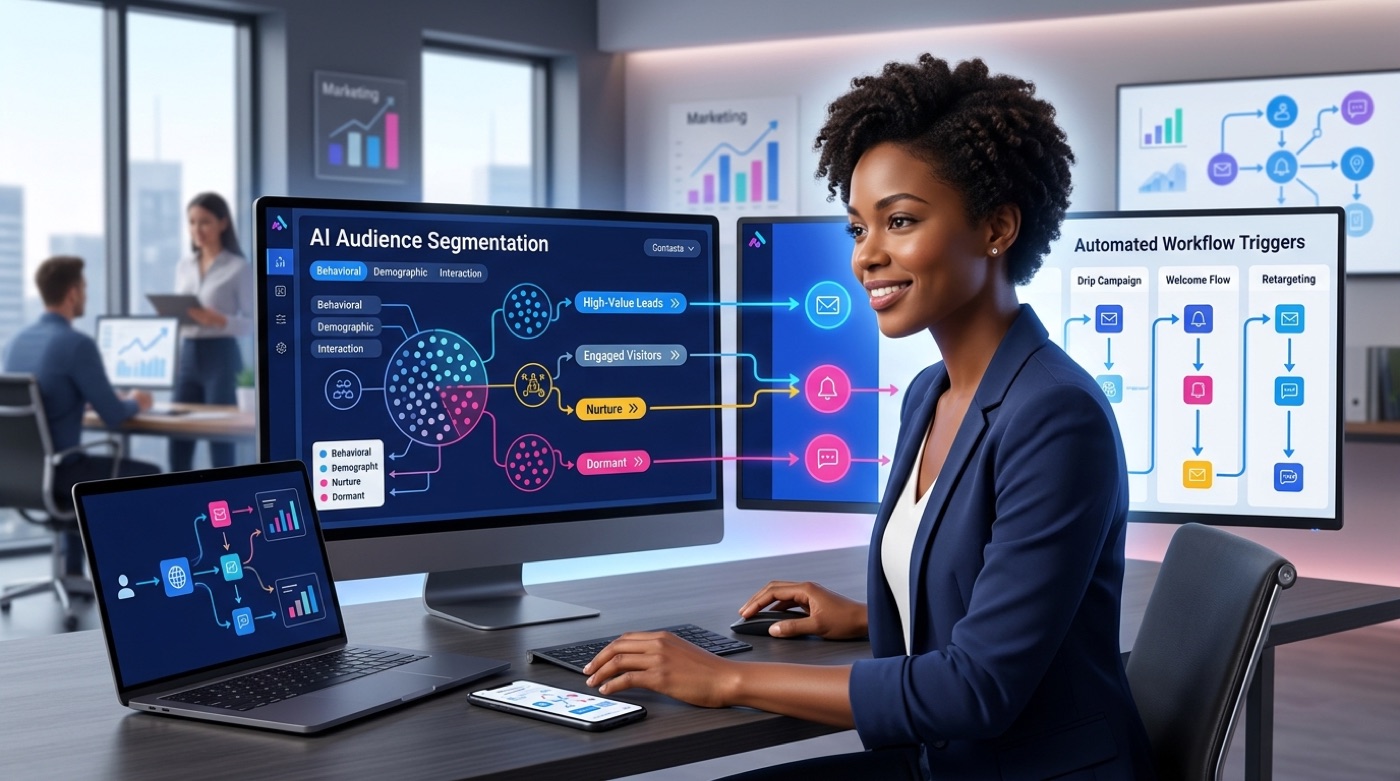
AI marketing automation platforms are usually adopted one workflow at a time rather than all at once. The seven areas below cover most of what teams automate first.
AI-suggested audience segmentation
Instead of a marketer manually defining “customers who bought in the last 90 days,” AI groups audiences by behavior, purchase history, and lifecycle stage automatically — and those segments keep updating themselves as new data comes in, so a contact can move from “browsing” to “high intent” without anyone touching a spreadsheet.
Predictive lead scoring and prioritization
The system scores and ranks leads by their likelihood to convert, so sales reps spend their limited time on the accounts most likely to close rather than working a list in the order it was entered into the CRM.
Adaptive lead nurturing sequences
Behavior-triggered drip campaigns adapt to each lead’s actions in real time — a lead who clicks a pricing page gets a different next email than one who only opened a newsletter, and the sequence branches automatically based on that signal.
Email marketing and send-time optimization
AI tools support prompt-to-campaign email creation, automated subject-line testing, and per-recipient send-time optimization, so the same campaign can land in one inbox at 8 a.m. and another at 6 p.m., depending on when each person actually opens email.
Content personalization at scale
Product recommendations, on-site content, and offer selection are tailored to each visitor automatically, based on their browsing and purchase signals rather than a single static homepage shown to everyone.
Cross-channel workflow orchestration and AI agents
AI coordinates messaging across email, SMS, paid ads, and the website so a customer sees a consistent, sequenced experience instead of disconnected campaigns. A newer layer of AI agents can now execute multi-step marketing tasks — building an audience, drafting copy, and launching a test — with minimal manual handoff between tools.
Chatbots and virtual assistants
Chatbots and virtual assistants provide instant support, lead qualification, and product guidance 24/7, capturing intent from visitors who arrive outside business hours instead of losing them to a contact form nobody answers until the next morning.

Best AI Marketing Automation Tools and Platforms
Several established marketing platforms have added AI-powered marketing automation on top of their existing automation engines, so the “best” choice usually comes down to what a team already runs rather than picking software in isolation.
HubSpot combines CRM, email, and AI-assisted content and lead scoring in one platform, which suits teams that want marketing, sales, and service data in a single system. Mailchimp focuses on email and SMS automation with AI-suggested send times and content, a common starting point for smaller teams. ActiveCampaign pairs automation workflows with predictive sending and lead scoring aimed at small and mid-size businesses. Klaviyo specializes in e-commerce personalization, syncing product and purchase data directly into automated flows. Salesforce Marketing Cloud and Marketo target larger organizations that need deep CRM integration and cross-channel orchestration at scale. Braze is built for customer engagement across mobile, web, and email for consumer brands with high message volume.
| Platform | Best for | AI-driven strength |
|---|---|---|
| HubSpot | All-in-one CRM + marketing teams | AI content assistance, predictive lead scoring |
| Mailchimp | Small teams, email-first | AI send-time optimization |
| ActiveCampaign | SMB automation workflows | Predictive sending, lead scoring |
| Klaviyo | E-commerce | Product-based personalization |
| Salesforce Marketing Cloud | Enterprise, Salesforce ecosystem | Cross-channel orchestration at scale |
| Marketo (Adobe) | Enterprise, B2B demand generation | Predictive lead scoring, account-based marketing |
| Braze | Consumer apps, mobile-first brands | Real-time cross-channel engagement |
How to Get Started with AI Marketing Automation
Adopting AI marketing automation works best as a staged rollout rather than a single big-bang launch:
- Define measurable goals and KPIs — conversion rate, cost per lead, time saved — so success can actually be measured against a baseline.
- Ensure data readiness before anything else launches, since a model trained on messy or incomplete data will make messy decisions.
- Pick one high-impact workflow to automate first, such as lead scoring or email send-time optimization, rather than trying to automate every channel simultaneously.
- Test on a small, defined segment before rolling the workflow out to the full list.
- Scale once results hold up outside the pilot group, then add the next workflow.
Compliance sits underneath all of this and cannot be an afterthought. Any automated email program sending to US recipients needs to follow the CAN-SPAM Act, enforced by the Federal Trade Commission, and any program touching EU residents’ data needs to follow the General Data Protection Regulation. Both set hard requirements — honoring opt-outs, disclosing sender identity, and obtaining valid consent for data processing — that AI automation does not exempt a company from; if anything, automating at scale makes it easier to violate them accidentally through a poorly configured workflow.

Benefits and ROI
AI marketing automation platforms mainly pay for themselves through a few consistent gains:
- Efficiency and productivity — tasks that took a marketer hours, like building 20 audience segments or drafting subject-line variants, now run in minutes.
- Higher conversion rates from personalization and better lead prioritization, since messages match intent instead of being generic.
- Faster campaign production, letting smaller teams ship more tests in the same window of time.
- Clearer performance insights, since the system is constantly scoring and reporting on what worked instead of waiting for a quarterly review to surface the pattern.
Frequently Asked Questions
- How can AI automate marketing?
By learning from customer data to segment audiences, score leads, personalize content, and trigger the right message automatically across channels — without a marketer manually building every rule.
- What is the 30% rule for AI?
It is a rough guideline for balancing automation with human oversight: let AI handle roughly 70% of high-volume, pattern-based work (like scoring, segmentation, and send-time decisions), while marketers keep the remaining 30% — strategy, creative direction, and final judgment calls — for themselves.
- Can ChatGPT help with marketing?
Yes — for content drafts, campaign ideas, and copy variations. But a full AI marketing automation platform is still needed to run automated workflows, connect to a CRM, and act on live customer data.
- What are the top AI platforms for marketing automation?
HubSpot, ActiveCampaign, Mailchimp, Klaviyo, Salesforce Marketing Cloud / Marketo, and Braze are among the most widely used AI-powered marketing automation platforms.
- Is AI marketing automation good for small business?
Yes — it lets small teams run sophisticated, personalized campaigns across email, SMS, and chat without adding headcount, since the system handles segmentation and send-time decisions automatically.
- Does AI replace marketers?
No — it automates repetitive tasks like scoring and segmentation so marketers can focus on strategy, creative direction, and customer relationships, which still require human judgment.