
AI Marketing Automation for Lead Nurturing: How to Turn More Leads Into Customers on Autopilot
AI lead nurturing uses machine learning to score, segment, personalize, and time every follow-up so no prospect goes cold — automatically, without a rep manually tracking each one. With AI marketing automation, a small team can run the same 1:1 nurture that once required a full marketing ops department.

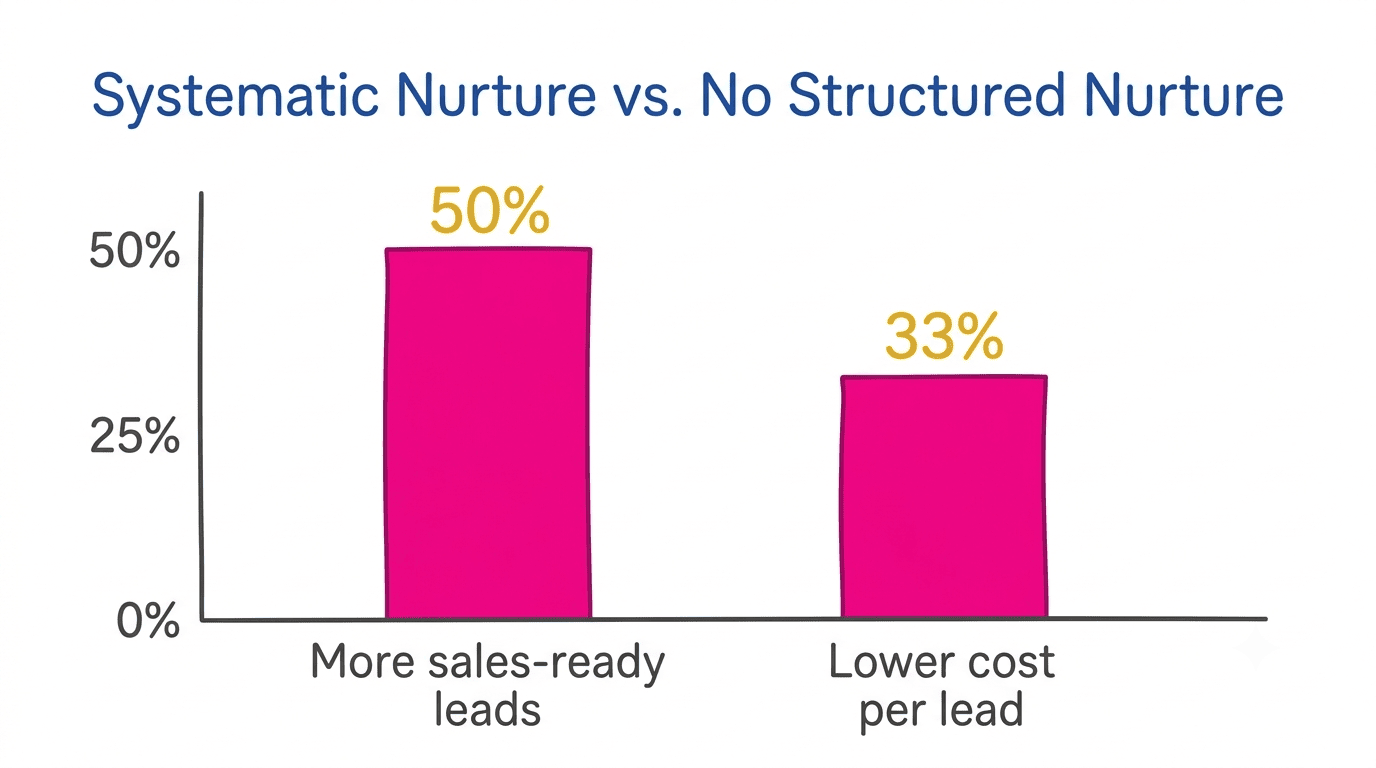
Companies that nurture leads systematically generate 50% more sales-ready leads at a 33% lower cost per lead than those that don’t, according to Forrester’s long-running lead-nurturing benchmark research. AI is how modern teams operationalize that gap at scale — tracking engagement and re-timing every touch per lead in a way a static drip campaign never could. This guide breaks down exactly how the pipeline works, what to hand to the AI, what to keep human, and which tools to start with.
What Is AI Lead Nurturing?
AI lead nurturing is the practice of applying machine learning and generative AI to the parts of the buyer journey that used to run on fixed rules — scoring, segmenting, writing, and timing every touch based on what a specific lead actually does, not a calendar a marketer set months ago. It sits on top of a marketing automation platform and a CRM, pulling data from both to decide who gets contacted, with what message, and when.
Definition: nurturing that runs itself
AI-driven lead nurturing automates lead scoring, personalization, timing, and follow-up so prospects get relevant touches across the buyer journey without someone manually building every sequence. That’s a real shift from traditional drip: static rules and a fixed calendar give way to behavior-driven, per-lead decisions that update as new signals come in. The stakes are practical, not theoretical — reps spend only about 40% of their week actually selling, with the other 60% eaten by admin work that AI-powered lead nurturing can absorb.
AI nurturing vs. traditional drip campaigns
Traditional drip sends the same sequence on the same timing to everyone who enters a list. Automated lead nurturing built on AI instead runs dynamic content, dynamic timing, and a dynamic path per lead, adjusting each one as behavior changes. That distinction matters commercially: 96% of marketers say personalized email content improves marketing performance, and independent surveys consistently put the share reporting a positive ROI from personalization overall in the high 80s to high 90s percent range. There’s also a line AI has to respect — seven emails in seven days feels like stalking, while seven touches spread thoughtfully across channels feels like nurturing.
How AI Lead Nurturing Works: The 5-Step Pipeline
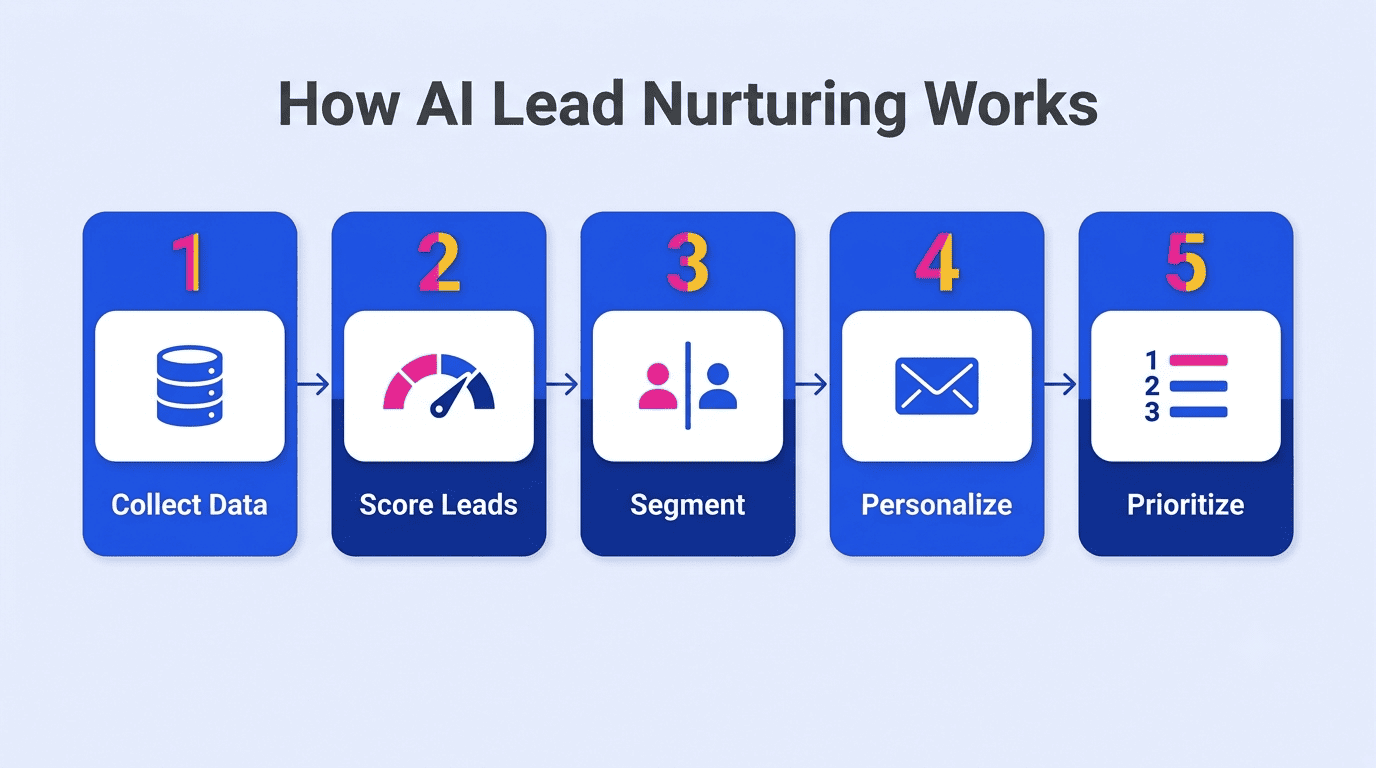
Underneath the marketing language, AI lead nurturing platforms run a fairly consistent pipeline: collect data, score leads predictively, segment dynamically, personalize outreach, and prioritize in real time. Salesforce frames it as five connected steps, and most vendors — from HubSpot to 6sense — implement some version of the same flow.
Step 1–2: Data collection and predictive lead scoring
The pipeline starts by pulling behavioral, firmographic, and intent data from the CRM, the website, email engagement, and third-party enrichment sources, then scoring each lead by likelihood to convert. Sales engagement platforms like Outreach layer buyer-intent signals — website visits, email engagement, CRM activity — on top of scoring models, while 6sense processes over 500 billion signals monthly across its network. Predictive lead scoring replaces static point thresholds — the old rule where hitting exactly 50 points made someone an MQL regardless of context.
Step 3–4: Dynamic segmentation and personalized outreach
Segments update in real time as behavior changes, instead of staying fixed once a lead is added to a list. Generative AI drafts per-persona copy and content gets matched to funnel stage — top, middle, or bottom of funnel — so a first-time visitor and a lead who just requested a demo never see identical messaging. Personalization at scale has moved well past mail-merge tokens; it now means genuinely tailored subject lines, content, and offers per segment.
Step 5: Real-time prioritization and send-time optimization
In the final step, AI surfaces the hottest leads to reps the moment intent spikes, and sends each touch at the individual recipient’s optimal time and channel. Speed is not a nice-to-have here — contact success drops more than 10x within the first hour after a lead shows interest. Yet 63.5% of teams never respond to a lead at all, and the ones who do respond average more than 29 hours.
What to Automate vs. What to Keep Human
Not every part of lead nurturing belongs to the AI, and drawing that line badly is one of the fastest ways to lose trust with a prospect. The general principle:
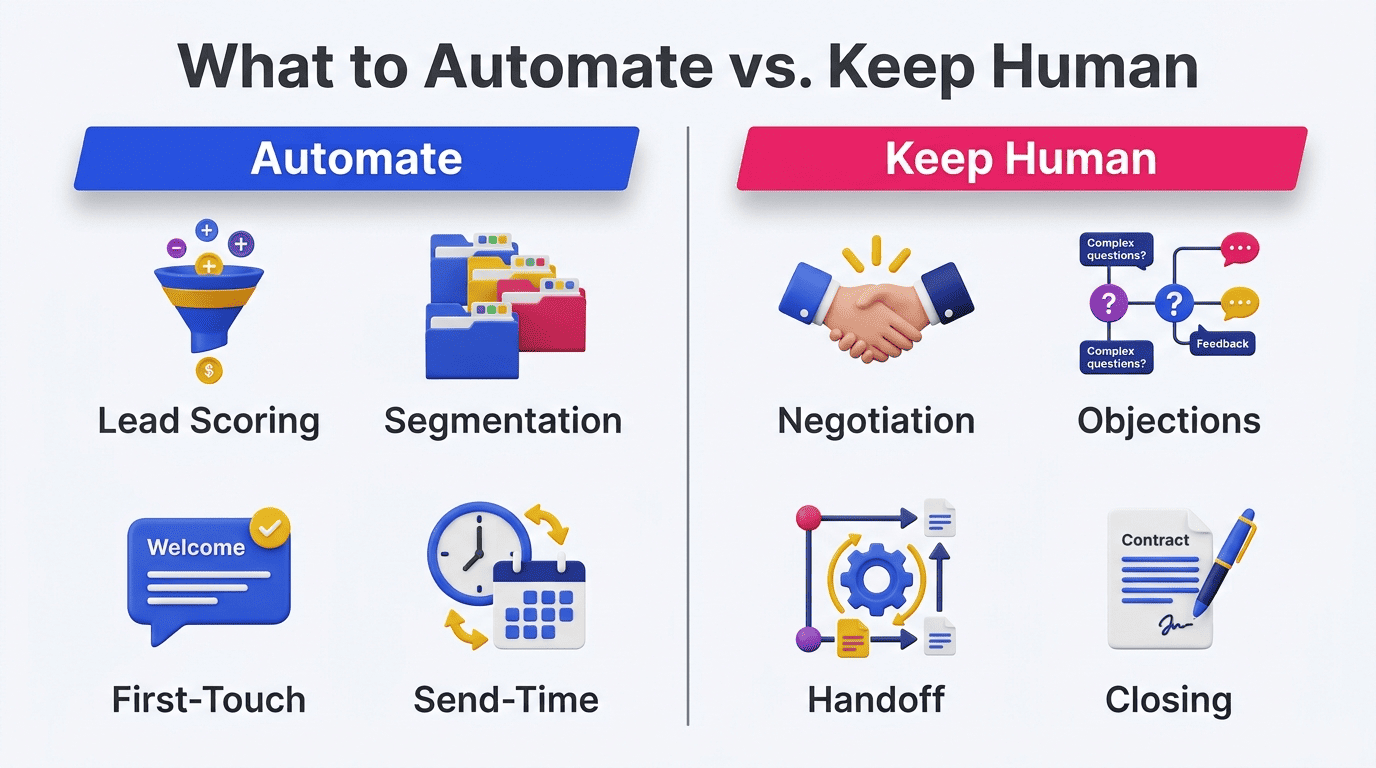
- Automate the repetitive, data-heavy layer
- Keep judgment and negotiation in human hands
- Escalate the moment a lead signals real buying intent
| Automate | Keep human |
|---|---|
| Lead scoring and re-scoring | Negotiation and pricing discussions |
| Dynamic segmentation | Complex or unusual objections |
| First-touch outreach and reminders | The high-intent handoff moment |
| Data entry and CRM hygiene | Judgment calls on relationship risk |
| Send-time optimization | Final closing conversations |
| A/B testing subject lines and cadence | Re-engaging a churned or sensitive account |
| Re-engagement of cold leads | Escalations and complaints |
Automate: the repetitive, data-heavy layer
Scoring, segmentation, first-touch messages, reminders, data entry, send-time decisions, A/B testing, and re-engagement of cold leads are all well suited to AI because they’re repetitive and data-driven, not judgment calls. The scale this unlocks is real: Salesforce’s AI agents contacted 130,000 previously untouched leads and produced 3,200 opportunities in four months — work no team could have done manually at that volume.
Keep human: judgment, negotiation, and the high-intent handoff
When a lead shows real buying intent, the system needs to hand off to a person fast, not keep the conversation going with a bot. Leads tend to forgive automation that’s fast and relevant; they punish automation that’s generic or that keeps talking over the exact moment a human should step in. The saved time is only valuable if a team actually uses it — AI-powered marketing automation frees up roughly 5 hours per rep per week, but 72% of teams fail to reinvest that time into real conversations.
The Business Impact: Benefits and Metrics
The case for AI marketing automation software isn’t just faster workflows — it shows up directly in pipeline numbers. Forrester’s benchmark research on lead nurturing, echoed by industry data from vendors like Madison Logic and Salesgenie, points to a consistent pattern: teams that nurture systematically outperform teams working from static drip or ad hoc follow-up, on both lead quality and cost.
The numbers on AI nurture
Systematic, AI-assisted nurture delivers measurably cheaper and more productive pipeline than static drip or ad hoc follow-up. Forrester’s long-cited lead-nurturing benchmark found that companies excelling at nurture generate 50% more sales-ready leads at a 33% lower cost per lead than companies that don’t nurture systematically. AI compounds that gap because it can track engagement and re-time every touch per lead automatically, at a volume no manual or calendar-based drip program can match — on top of freeing reps roughly 5 hours a week that would otherwise go to manual follow-up and admin work.
| Metric | Systematic/AI-assisted nurture vs. no structured nurture | Source |
|---|---|---|
| Sales-ready leads | +50% | Forrester lead-nurturing benchmark |
| Cost per lead | -33% | Forrester lead-nurturing benchmark |
| Rep time freed up by AI automation | ~5 hrs/week | Gartner, 2026 |
| Overwhelmed sellers’ odds of hitting quota | -45% | Gartner |
Why it compounds
A typical B2B buying cycle involves 11 stakeholders spread across 6 to 12 months, and every one of them needs to stay warm for a deal to survive. AI keeps each stakeholder engaged across that entire window without a rep manually tracking who saw what and when — that consistency, applied at scale, is where most of the gain in the table above actually comes from.
AI Lead Scoring and Predictive Analytics in Depth
Predictive lead scoring is the entity that shows up in every competitor covering this topic, and for good reason — it’s the mechanism that decides who a rep talks to first. Understanding how it actually differs from the old point-based systems explains most of the accuracy gain.
From static points to living scores
Static scoring gives every «pricing page visit» the same value forever, regardless of when it happened. AI-based predictive analytics applies decay instead — a visit today counts far more than one from nine months ago — and continuously reweights signals as buying patterns shift across the account base. This is exactly why clean data matters so much: 74% of sales professionals now prioritize data cleansing to get more value from AI, per Salesforce’s 2026 State of Sales report — the same precondition predictive scoring depends on.
Intent signals and ICP fit
AI blends behavioral intent signals — what a lead actually does — with ideal customer profile (ICP) fit, or who they are, so that a high-fit, high-intent lead outranks someone who’s merely curious. Typical signals that feed this blend include:
- Pricing or demo-page visits
- Content downloads and email opens
- Firmographic fit (industry, company size, tech stack)
- Enrichment data that fills gaps in a bare CRM record
Data enrichment specifically adds the firmographic and technographic detail the platform needs to judge fit accurately when a raw form-fill leaves those fields blank.
Personalization and Omnichannel Timing at Scale
Personalization at scale and omnichannel engagement are where AI marketing automation software diverges most visibly from a traditional email-only drip sequence. Instead of one channel and one script, the system adapts both the content and the delivery channel per lead.
Content that adapts to each lead
Generative AI drafts per-segment copy and swaps calls to action based on funnel stage automatically, rather than pulling from one static template for every recipient. A typical example: an abandoned-cart sequence built around three touches — a reminder within hours of the drop-off, a follow-up highlighting benefits, and a discount offer sent shortly before it expires.
Right channel, right moment
AI picks the channel — email, SMS, LinkedIn, or chat — and the exact time per person, not per campaign, based on when that individual has historically engaged. Omnichannel spread reliably beats email-only frequency, because spreading touches across channels is what prevents the «stalking» effect described earlier: the same seven touches that feel invasive crammed into one inbox read as attentive when spaced across platforms.
Best AI Marketing Automation Tools for Lead Nurturing
Marketing automation with AI isn’t one product category — it’s a stack of five layers, and most teams only need two or three of them running at once to see results.
The five-layer nurture stack
The layers break down as:
- Intelligence — platforms like 6sense that surface predictive intent signals
- Content — generative AI that drafts and adapts copy per segment
- Orchestration — HubSpot, Marketo Engage, ActiveCampaign
- Sales engagement — Outreach, Salesloft
- Conversational — chat and AI SDR tools
Most teams don’t need all five on day one — orchestration plus a layer of intelligence covers the majority of early use cases.
| Tool | Best for | Starting price |
|---|---|---|
| HubSpot | SMB orchestration, all-in-one CRM + automation | ~$20/mo (scales to $890–$3,600/mo) |
| ActiveCampaign | SMB automation, 135+ triggers, 900+ integrations | $15–$145/mo |
| 6sense | Mid-market intent data and predictive scoring | ~$50,000–$60,000/yr |
| Clay | Data enrichment, 75+ enrichment source integrations | Usage-based, credit tiers |
| Salesforce Einstein / Agentforce | Enterprise AI SDR and agentic nurture | Enterprise pricing |
Picking by team size and budget
For an SMB or starter budget, HubSpot and ActiveCampaign cover most orchestration needs. HubSpot starts around $20/month and scales up to $890 and $3,600/month tiers as a team grows, while ActiveCampaign runs $15 to $145/month with more than 135 automation triggers and over 900 integrations. Mid-market teams chasing intent data typically look at 6sense, priced around $50,000 to $60,000 a year. Teams that live and die on data enrichment tend to pick Clay, which connects to more than 75 enrichment tools. The right call depends on where the team expects to be in three years, not just what fits this quarter’s budget.
How to Set Up Your First AI Nurture Workflow
Getting an AI nurture workflow live doesn’t require a multi-month rollout. Martal’s own self-serve AI platform, for instance, can go from ICP definition to a live campaign in under 30 minutes once the underlying data is clean — a reasonable proxy for how fast modern nurture tooling has gotten. The real time investment goes into preparation, not configuration.
A 6-step starter checklist
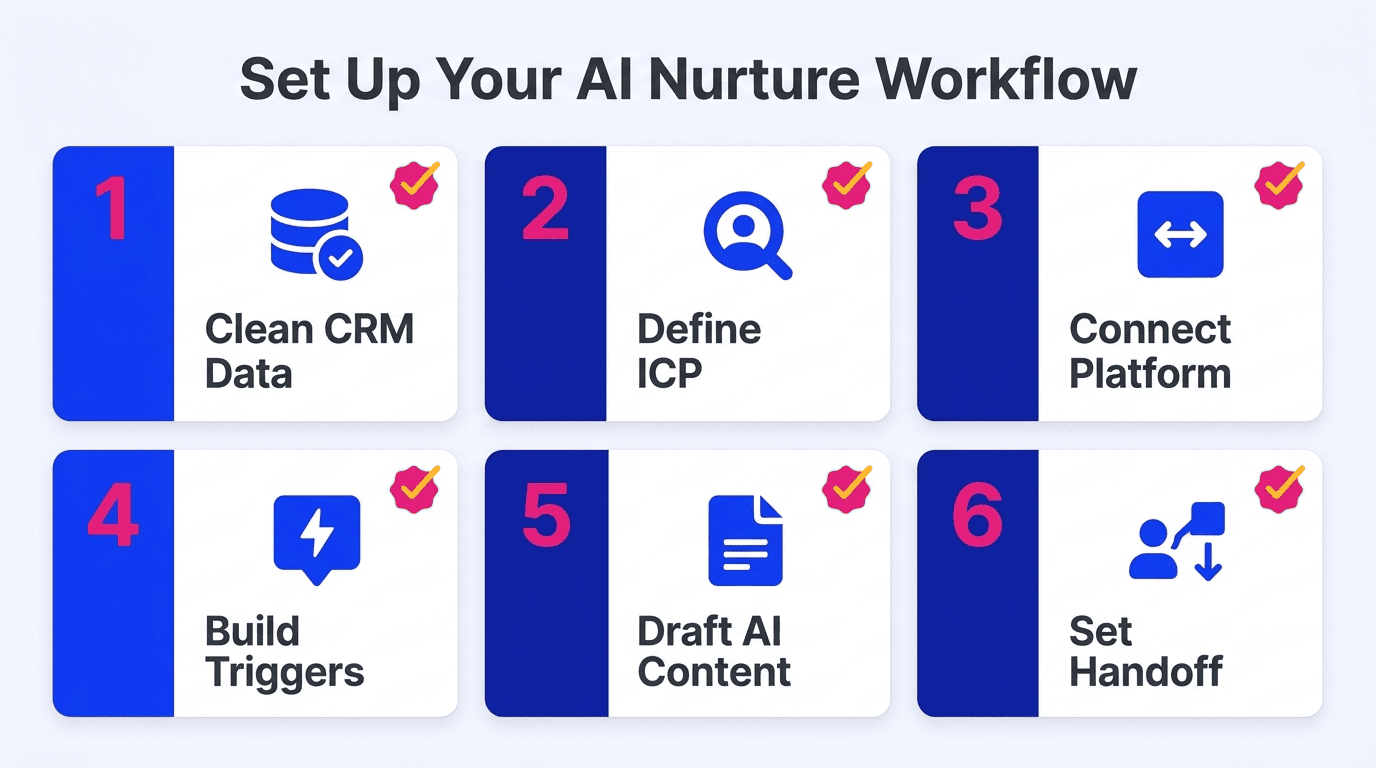
- Clean and enrich existing CRM data before connecting anything else.
- Define the ideal customer profile (ICP) and the specific scoring signals that matter for it.
- Connect the marketing automation platform to the CRM.
- Build behavior-based triggers — visited the pricing page, opened a specific email, or went cold for 30 days.
- Draft AI-generated content per segment and funnel stage.
- Set the exact threshold where the AI hands a lead off to a human rep.
Test, review, and hand off
A/B test subject lines and cadence early, since assumptions about the right send time or message rarely hold across an entire lead base. Review scoring weekly at first while the model calibrates, then shift to monthly or quarterly reviews once performance stabilizes. Whatever else changes, always define explicitly where the AI hands off to a human — leaving that threshold vague is where most nurture programs quietly fail.
Data Quality, Compliance, and Common Pitfalls
None of the gains described above hold up if the underlying data is dirty or the program ignores privacy law. Two failure modes show up repeatedly across teams adopting AI marketing automation software: bad data and over-automation.
Garbage in, garbage out
AI scoring is only as good as the data feeding it. Dirty CRM data produces bad scores, and bad scores drive reps toward the wrong leads at the wrong time — enriching and deduplicating records has to happen before scoring, not after.
Compliance and over-automation
Privacy regulation isn’t a side note for AI-driven nurture — it directly governs what data the system is allowed to use for scoring and personalization in the first place.
The controller and the processor shall implement appropriate technical and organisational measures to ensure a level of security appropriate to the risk, including inter alia as appropriate: the pseudonymisation and encryption of personal data.
GDPR, Article 32
AI lead nurturing has to honor GDPR and CCPA on consent, data use, and opt-outs — that isn’t optional once personal data crosses borders or California residents are in the database. The California Attorney General’s office publishes the current CCPA compliance requirements directly for reference. Beyond legal exposure, there’s a productivity trap: 50% of sellers report feeling overwhelmed by the number of tools in their stack, and that group is 45% less likely to hit quota. More automation tools don’t automatically mean more results — the actual win is reinvesting the time AI saves into human selling, not stacking on another platform.