
AI Marketing Automation for Email Marketing: The Complete 2026 Guide
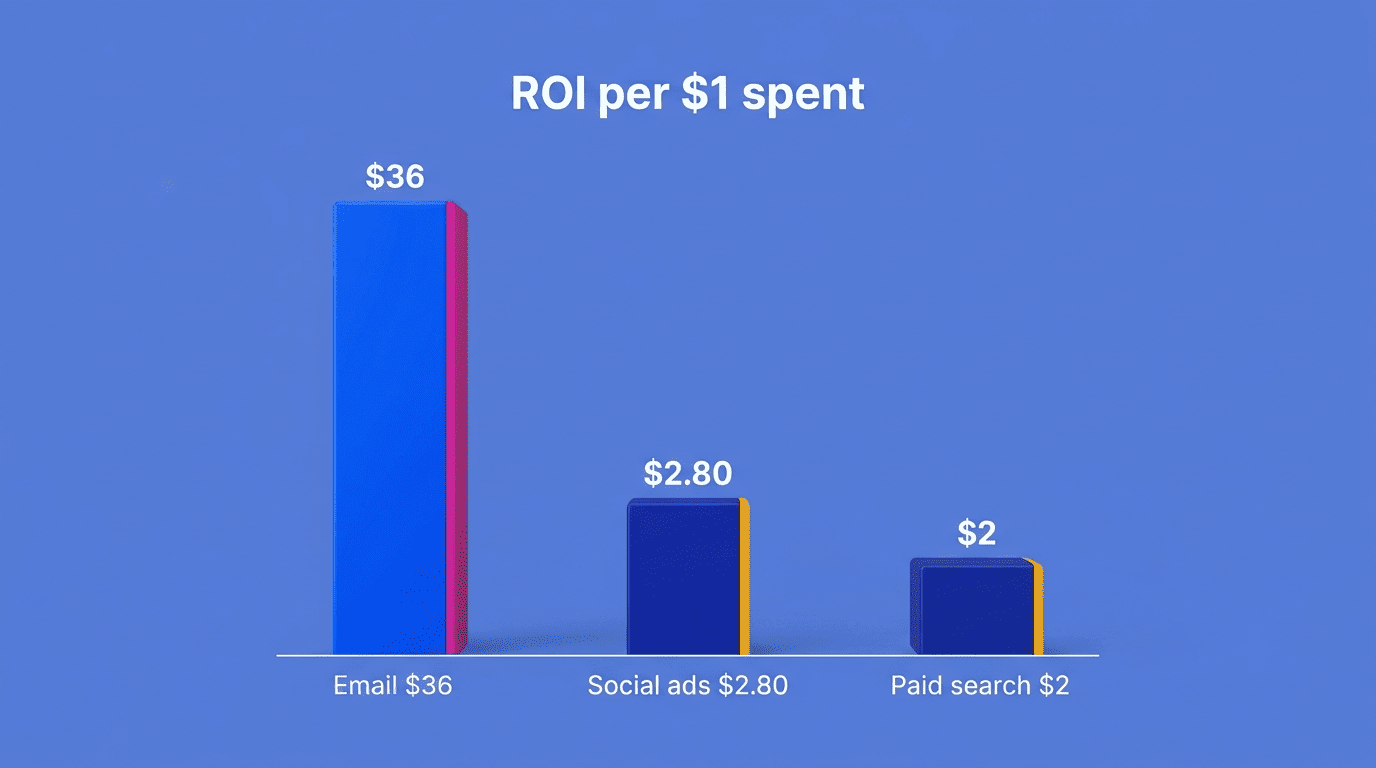
Email still returns $36-$40 for every $1 spent, but only when the right message lands in the right inbox at the right moment. That is exactly the problem AI marketing automation solves for email, according to data cited by Salesforce in its 2026 email marketing guide. Instead of static lists and one-size-fits-all blasts, machine learning now builds segments, times sends, writes subject lines, and predicts who is about to churn — automatically.

This guide covers the six core capabilities behind AI-driven email marketing, seven of the leading tools and what they cost, the metrics that actually move with AI, and a five-step workflow for building your first automation.
What Is AI Marketing Automation for Email?
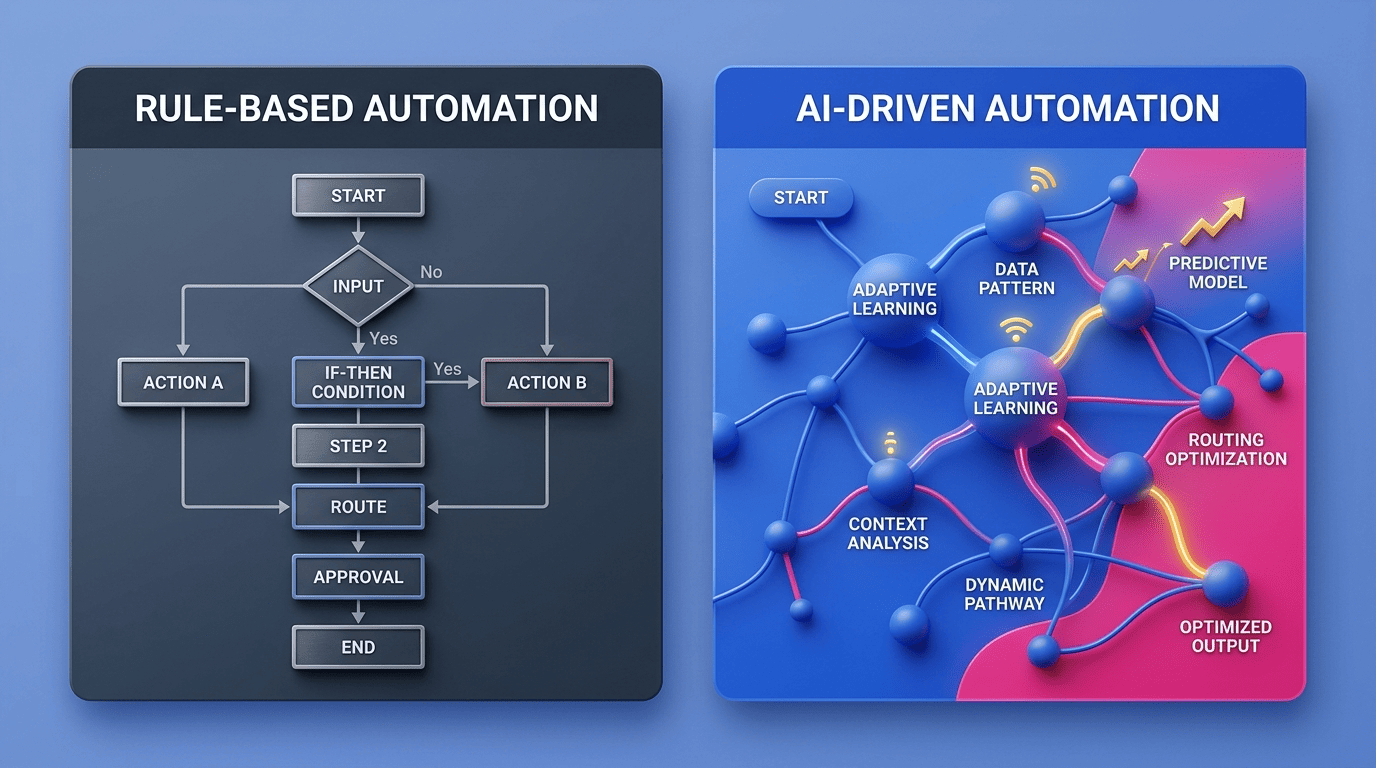
AI marketing automation for email means using generative and predictive AI to run the parts of an email program that used to require a human decision every time — who gets an email, what it says, and when it arrives. Traditional automation follows fixed rules: if a contact abandons a cart, send email B three hours later. AI-driven email marketing goes further because the system learns from outcomes and adjusts on its own.
Definition: automation vs. AI-driven automation
Classic email automation runs on static triggers and rules set once by a marketer — a welcome series fires the same way for every new subscriber, forever. AI-driven automation replaces fixed logic with models that keep learning: generative AI writes and rewrites content on the fly, predictive models score every contact continuously, and the system optimizes send timing per person rather than per campaign. The rules do not need to be rewritten by hand every time behavior shifts; the model adapts.
Why it matters now
Email has 4.83 billion users worldwide in 2025, a figure projected to reach 5.61 billion by 2030, and 99% of those users check their inbox every single day. That scale is exactly why email marketing has become the natural testing ground for AI: 63% of marketers already use AI somewhere in their email workflow, and roughly seven in ten marketers report applying AI to marketing tasks generally, according to Statista. With average ROI sitting between $36 and $40 per dollar spent, even small gains in targeting or timing compound fast across millions of sends.
How AI Automates Email Marketing: 6 Core Capabilities
Generative AI email marketing tools now touch nearly every stage of a campaign, from list-building to the words in the subject line. In one industry survey, 95% of marketers said generative AI is effective for their work, and 54% called it «very effective» — a sign the technology has moved well past the pilot stage.
| Capability | What AI does | Typical result |
|---|---|---|
| Smart segmentation | Groups contacts by real-time behavior, not static fields | Fewer irrelevant sends |
| Personalization at scale | Generates 1:1 content and product picks per recipient | Higher engagement per email |
| Send-time optimization | Predicts the best moment to email each contact | Higher open rates |
| Content & subject line generation | Drafts subject lines, preheaders, and body copy | Faster production, more variants tested |
| Behavioral trigger automation | Fires flows off real actions (cart, signup, inactivity) | Timely, relevant follow-up |
| Predictive analytics & lead scoring | Forecasts churn, lifetime value, purchase intent | Better prioritization of contacts |
1. Smart segmentation
Instead of a marketer manually building a list of «customers who bought in the last 90 days,» AI-driven segmentation clusters contacts by actual behavior — browsing patterns, purchase history, and engagement signals pulled from first-party data. Some newer platforms let marketers describe a segment in plain language and have the model build it automatically, replacing spreadsheets of manually maintained lists.
2. Personalization at scale
Generative AI turns one email into thousands of individual versions. It writes unique subject lines, swaps product recommendations, and adjusts tone per recipient, all from a single template. Bloomreach’s research on AI in email marketing found that this kind of contextual personalization consistently lifts engagement compared with generic, batch-and-blast sends.
3. Send-time optimization
Predictive send-time models analyze when each individual contact historically opens email and schedule that person’s message for their personal peak window, rather than sending the whole list at 9 a.m. on a fixed schedule.
4. AI content and subject line generation
AI now drafts subject lines, preheader text, and full email bodies from a brief or a set of brand assets. Salesforce has documented marketers who scaled their A/B testing roughly tenfold with generative AI, since the model can produce dozens of subject-line variants — and test user behavior, not just copy — in the time it used to take to write two. Mailchimp’s Creative Assistant, for example, assembles a first-draft email directly from a brand’s existing logo, colors, and copy style.
5. Behavioral trigger automation (drip and flows)
Welcome series, abandoned-cart reminders, and re-engagement campaigns fire automatically off real user actions rather than a calendar. AI adds a layer on top of these flows by deciding which variant of the message, and which send time, fits each recipient.
6. Predictive analytics and lead scoring
Predictive models forecast which contacts are likely to churn, estimate customer lifetime value, and score leads by purchase probability, so sales and marketing teams can prioritize the contacts most likely to convert instead of treating every lead the same.
AI Email Personalization and Segmentation in Practice
Automating your marketing with AI shows up most clearly in personalization results, because segmentation and content generation compound: better segments feed better content, and AI handles both simultaneously.
The data demonstrates what marketers have suspected since the start of the AI boom — that fully embedding AI across your operations significantly increases your email ROI.
Cynthia Price, SVP of Marketing, Validity
From static lists to dynamic AI segments
Legacy email programs relied on lists that a marketer updated by hand every few weeks. AI-powered platforms rebuild segments continuously, pulling from a customer data platform (CDP) or another first-party data source so that a contact who just browsed a new product category shows up in the relevant segment within minutes, not the next scheduled list refresh.
Real results from personalization
The gains from AI personalization are documented in several published case studies. Brewdog saw a 13.8% revenue increase, along with 15.6% more clicks and an 11.5% higher conversion rate, after adopting AI-driven personalization in its email program with Bloomreach. On The Beach went further with a dynamic, AI-monitored price-drop campaign: a split test showed a 362% uplift in revenue per visitor, a 180% uplift in conversion, and a 95% uplift in click-through rate, according to Bloomreach’s case data. SAP’s Emarsys platform has published similar open-rate and revenue gains from AI-driven personalization across its customer base, underscoring that the pattern holds across vendors, not just one platform.
Deliverability, Testing and Optimization with AI
Getting an email written and personalized is only half the job — it also has to land in the inbox, not the spam folder, and AI now plays a growing role in that step too.
AI-driven deliverability
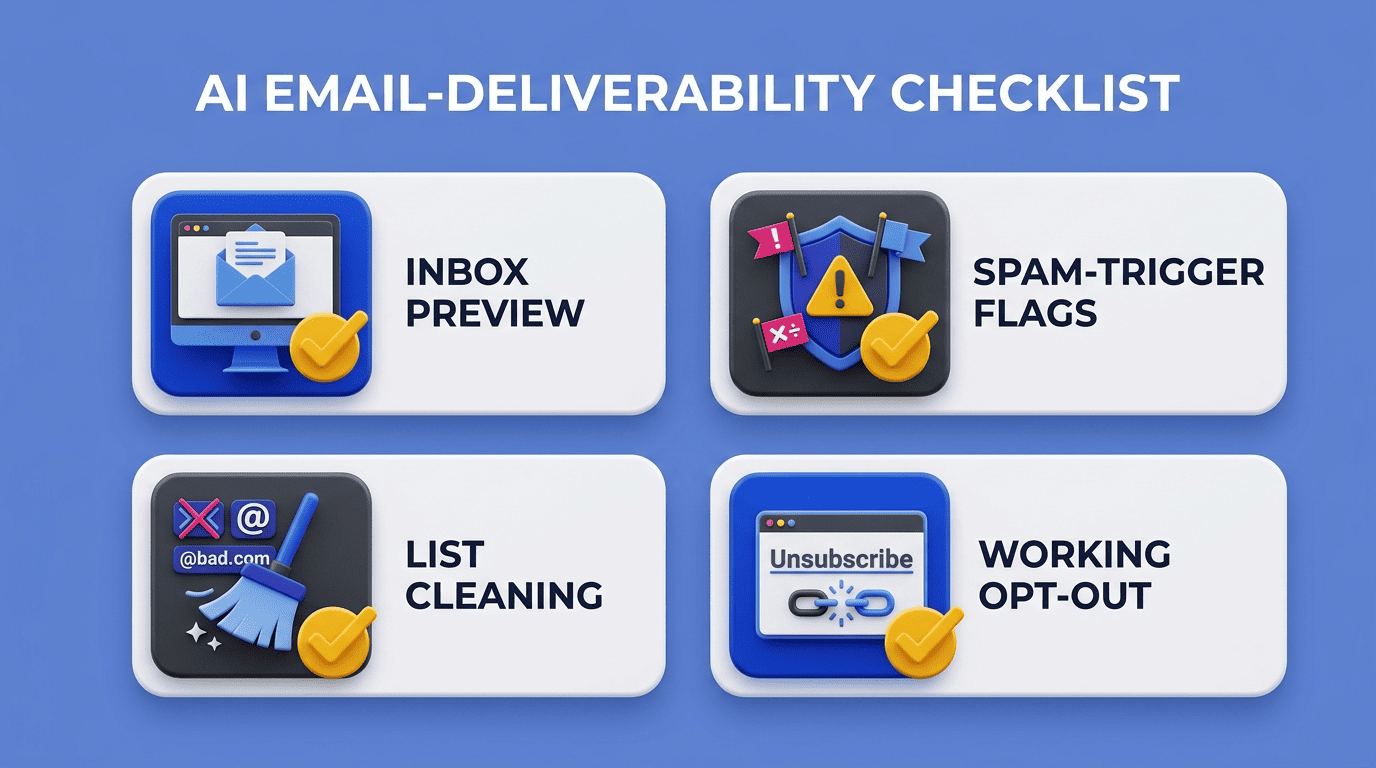
AI-powered deliverability advisors preview how an email will render across inbox providers, flag content likely to trigger spam filters, and clean subscriber lists of inactive or invalid addresses before they hurt sender reputation. Emarsys’s Deliverability Advisor is built to help customers hit up to 99% deliverability, and independent inbox-placement testing has put ActiveCampaign around 94.2%, backed by more than 135 available automation triggers marketers can combine into flows. None of this removes the baseline legal requirements every automated sender still has to meet — accurate headers, an honest subject line, and a working opt-out link, as set out in the FTC’s CAN-SPAM Act compliance guide.
Continuous A/B and multivariate testing
Where manual A/B testing might compare two subject lines once per campaign, AI-driven testing runs continuously and at a larger scale, testing multiple variables at once — subject line, send time, and content block — and automatically shifting send volume toward the best-performing version as results come in.
Best AI Email Marketing Automation Tools in 2026
Picking a platform for AI-driven email marketing comes down to list size, the channels you need beyond email, and how much predictive functionality is actually built in versus bolted on. Most of the tools below started as email-only platforms and have since expanded into broader AI-driven marketing automation, so it is worth checking whether a tool’s roadmap covers the other channels your team plans to automate next.
Comparison table
| Tool | Key AI feature | Starting price | Best for |
|---|---|---|---|
| Mailchimp | Creative Assistant, send-time optimization | From $13/month (free plan up to 250 contacts) | Small businesses, ecommerce |
| Klaviyo | AI-powered email and SMS personalization | Free tier, paid plans from $20/month | Ecommerce, Shopify integrations |
| ActiveCampaign | Predictive sending, 135+ automation triggers | From $15/month (billed annually) | SMB automation and CRM |
| HubSpot | AI content assistant, lead scoring | Starter from ~$15/seat/month (exact rate varies by billing term and promotions) | Inbound marketing, sales alignment |
| Brevo | AI subject line optimizer | Free up to 300 emails/day | Budget-conscious teams |
| Encharge | Behavior-based AI flows | Usage-based pricing | SaaS lead nurturing |
| Salesforce Marketing Cloud | Einstein AI predictive analytics | Enterprise pricing (quote-based) | Large enterprises |
Prices above are starting-tier estimates as published by each vendor and should be treated as a general guide, not a live quote — always confirm current pricing on the vendor’s site before budgeting.
How to choose
Four factors decide which platform fits:
- List size and growth plans — pricing on most platforms scales with contacts or profiles, so check the cost at your list size a year from now, not just today
- Channels beyond email — some tools bundle SMS and push, others stay email-only
- Predictive analytics needs — lead scoring and churn forecasting are standard on some platforms and an add-on (or missing) on others
- Integrations — how well the tool connects to your existing CRM or ecommerce stack, such as Shopify or a CRM system
How to Build Your First AI Email Automation Workflow
Building an AI-driven email workflow follows roughly the same sequence regardless of which platform you choose — the tool changes, the steps do not.
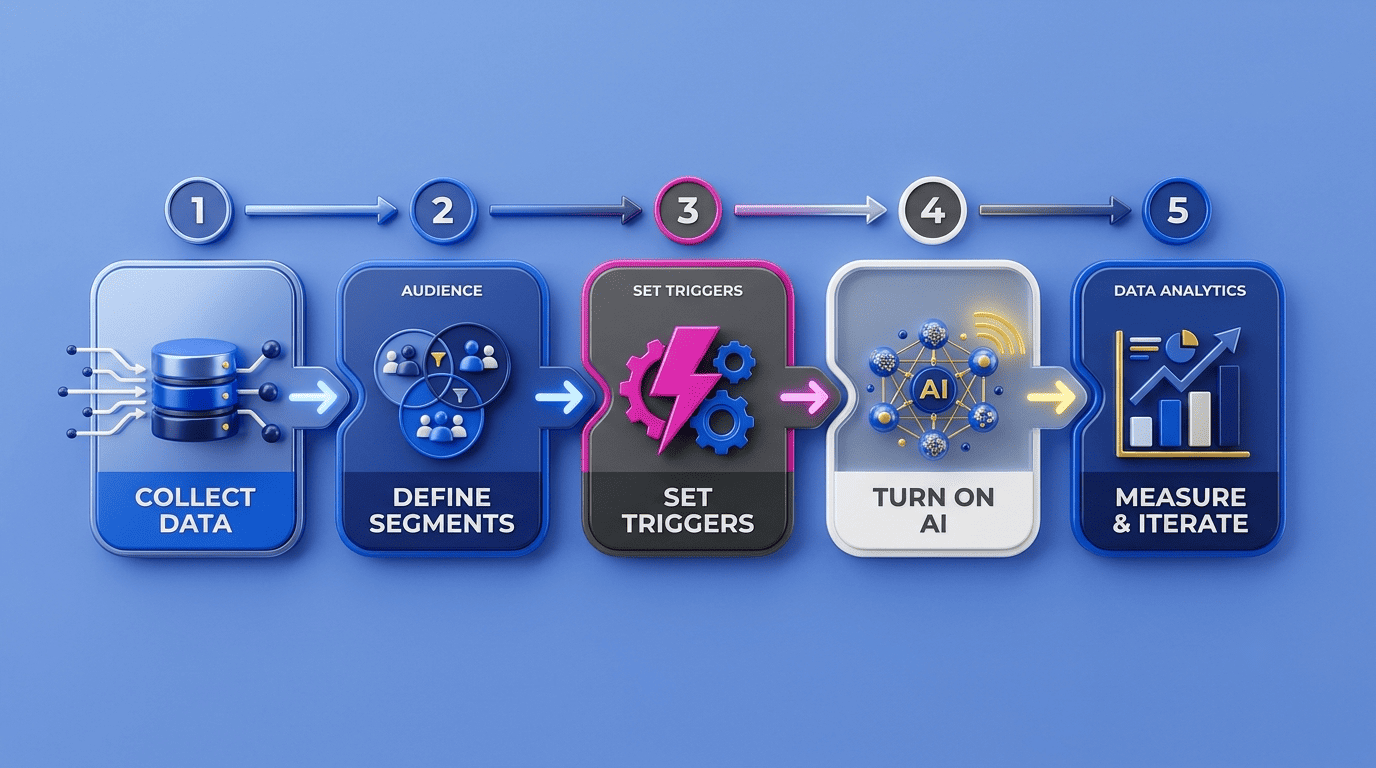
Step-by-step (5 steps)
- Collect and clean first-party data. Pull behavioral and transactional data into a CDP or your email platform’s native data layer; AI segmentation and personalization are only as good as the data feeding them.
- Define your segments and goals. Decide what success looks like for this workflow — reactivation, onboarding, upsell — before turning on automation.
- Choose your triggers and flows. Set up the behavioral events that will fire messages: signup, cart abandonment, inactivity, or a purchase.
- Turn on AI features. Enable send-time optimization, AI personalization, and subject-line generation within the flow rather than running it as a static sequence.
- Measure and iterate. Track performance weekly and let the predictive model retrain on new outcomes rather than treating the workflow as «set and forget.»
The payoff from following this sequence is well documented: Landbot reported saving 320 hours per month after automating its email workflows with AI, Confect saw a 28% increase in engagement, and Samdock cut customer acquisition cost by 77%, according to case studies published by Encharge.
Common mistakes to avoid
- Feeding AI models messy or incomplete first-party data, which produces bad segments and bad personalization
- Over-automating without any human review of AI-generated subject lines or copy before it ships
- Ignoring deliverability signals while chasing personalization gains
- Turning on AI features without a baseline to measure whether they actually improved performance
Metrics and ROI: Measuring AI Email Performance
Automating email with AI only pays off if the metrics that matter are actually moving, so it is worth tracking a consistent set of KPIs before and after adoption rather than judging the switch on gut feel.
KPIs that matter
Seven numbers are worth tracking before and after adopting AI:
- Open rate
- Click-through rate
- Conversion rate
- Revenue per email
- Deliverability rate
- List growth
- Unsubscribe rate
AI typically moves open rate and CTR first, through send-time optimization and subject-line testing; revenue per email and conversion follow once personalization and predictive targeting mature. Industry-wide, email still delivers $36-$40 in ROI per $1 spent, and 95% of marketers rate generative AI as effective for their programs, with 54% calling it very effective — a strong signal that the investment in AI marketing automation for email marketing is translating into measurable results, not just efficiency gains.
FAQ
To see how AI marketing automation extends beyond email into segmentation, lead scoring, and full-funnel workflows, automate your marketing with AI across every channel your team runs, not just the inbox.