
AI Marketing Automation for Personalization at Scale: The 2026 Playbook
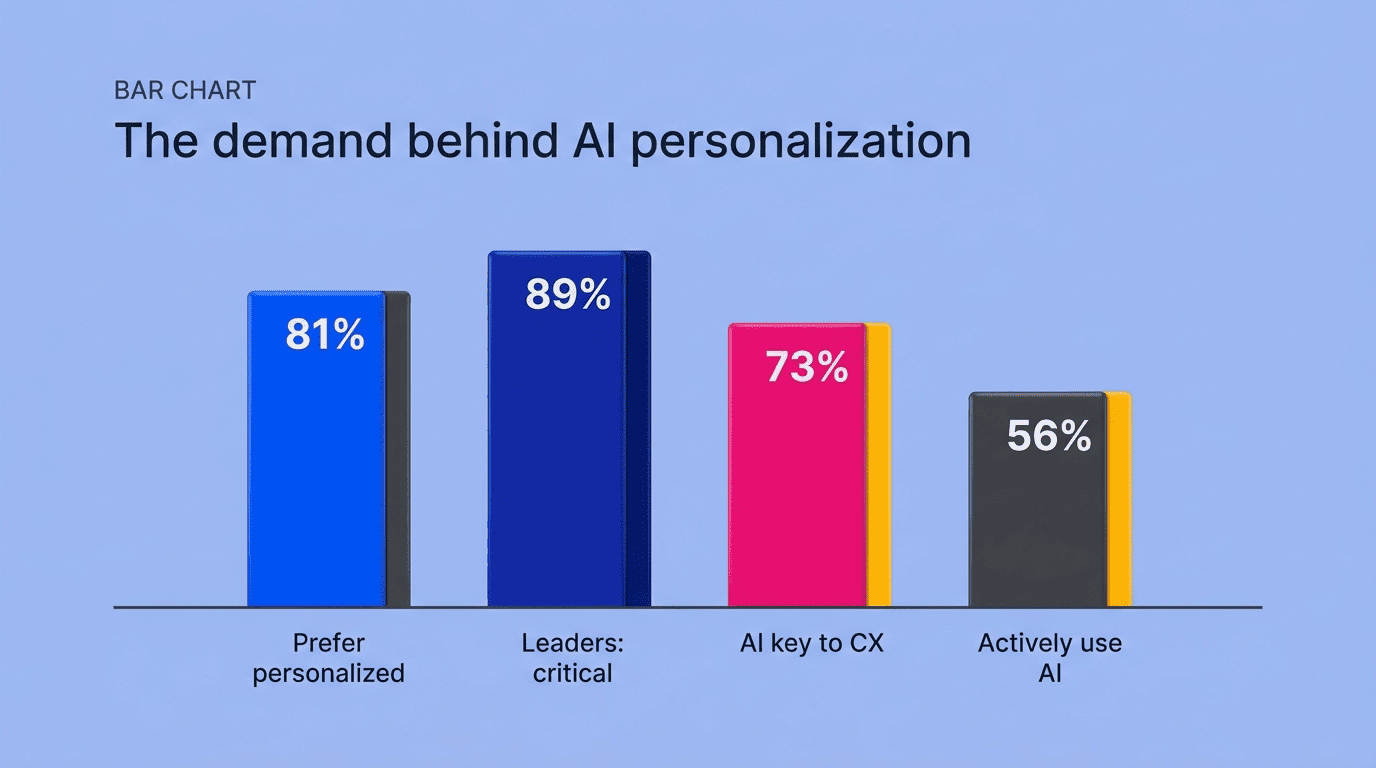
Eighty-one percent of customers now expect every brand interaction to feel tailored to them, yet no team can hand-write a million individual messages. AI marketing automation closes that gap by pairing generative and predictive models with first-party data, so a single system can decide what to say, show, and send to each person in real time. According to Twilio Segment’s State of Personalization Report, 89% of marketing leaders consider personalization critical to their business over the next three years.

This guide covers how the mechanics actually work, the data foundation they depend on, where AI personalization shows up in a real campaign stack, and where it can go wrong — plus the metrics that separate a working program from an expensive experiment.
What Is Personalization at Scale?
Personalization at scale means delivering an individually relevant experience to millions of customers without a human writing or approving each one. It sits at the top of a ladder that starts with broad segments, narrows into micro-segments, and ends at true one-to-one personalization — a progression the trade press has started calling hyper-personalization when it layers in real-time context and behavior.
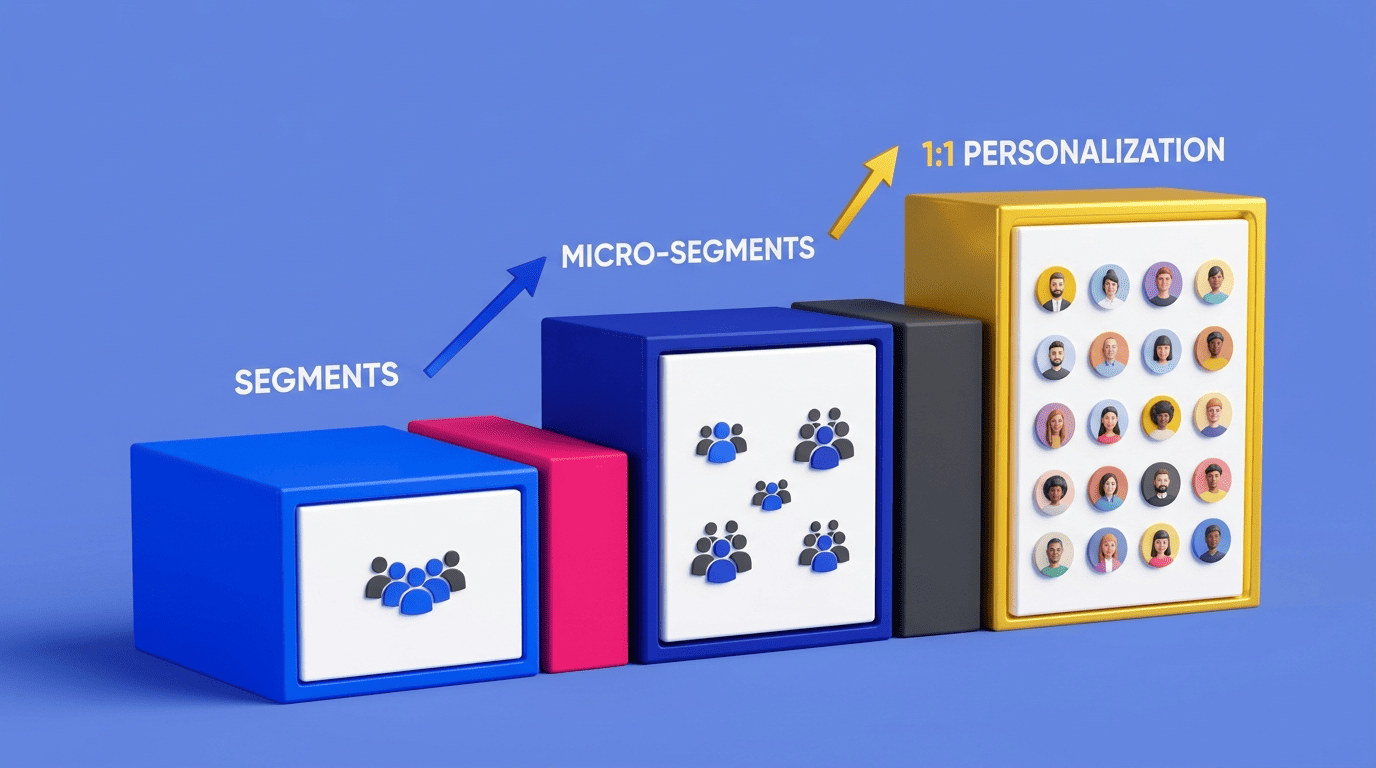
Definition: from segments to 1:1
A traditional campaign might split customers into five or six segments by age or purchase history. Personalization at scale collapses that ladder: instead of a segment getting one message, each person gets a version shaped by their own browsing, purchase, and engagement signals. Hyper-personalization pushes further still, adjusting content and offers based on what a customer is doing right now — the device they’re on, the page they just viewed, even the time of day.
Why it matters now
The demand curve behind this shift is steep. 81% of customers say they prefer personalized experiences over generic ones, and 89% of marketing leaders rate personalization as critical within three years. The market is following the demand: spend on customer-experience personalization software is projected to top $11.6 billion by 2026, and broader AI-in-marketing spending is forecast to reach $217.33 billion by 2034.
| Metric | Figure |
|---|---|
| Customers who prefer personalized experiences | 81% |
| Marketing leaders who call personalization critical (3-year horizon) | 89% |
| CX-personalization software market by 2026 | $11.6B+ |
| AI-in-marketing market forecast by 2034 | $217.33B |
How AI Automation Delivers Personalization at Scale
The mechanism behind personalization at scale is consistent across tools and industries, even when the branding differs. AI-driven marketing automation reads behavioral and contextual signals, forecasts what a customer is likely to want, generates content suited to that individual, and times delivery to the moment it will land best.
The core mechanism
The system ingests real-time behavior and context, runs it through predictive models to estimate intent, then hands the result to a generative layer that produces individualized copy, offers, or product sets. That output goes out through whatever channel the customer is using at that moment. 56% of marketers say they are actively using AI in their campaigns today, and 73% consider AI a key factor in delivering personalized customer experiences.
Automation is what makes it scale
Manual personalization never scales past a handful of segments. A person can reasonably write and test messaging for five customer groups; nobody can do it for five million individuals. Automation is the piece that turns «we know what each customer wants» into «we’re actually delivering it,» executing decisions a marketing team defines in strategy but could never carry out by hand. That shift also tracks with Salesforce’s finding that a majority of marketers say new-customer acquisition itself is getting harder — a gap AI-driven automation is increasingly asked to close, not just for retention.
Companies that excel at personalization generate 40 percent more revenue from those activities than average players.
McKinsey & Company
The Data Foundation: First-Party Data and CDPs
No personalization engine performs better than the data feeding it. Predictive models and generative content only look sharp when they’re built on first-party and zero-party data that’s actually accurate and unified — otherwise the output is a confident guess pointed in the wrong direction.
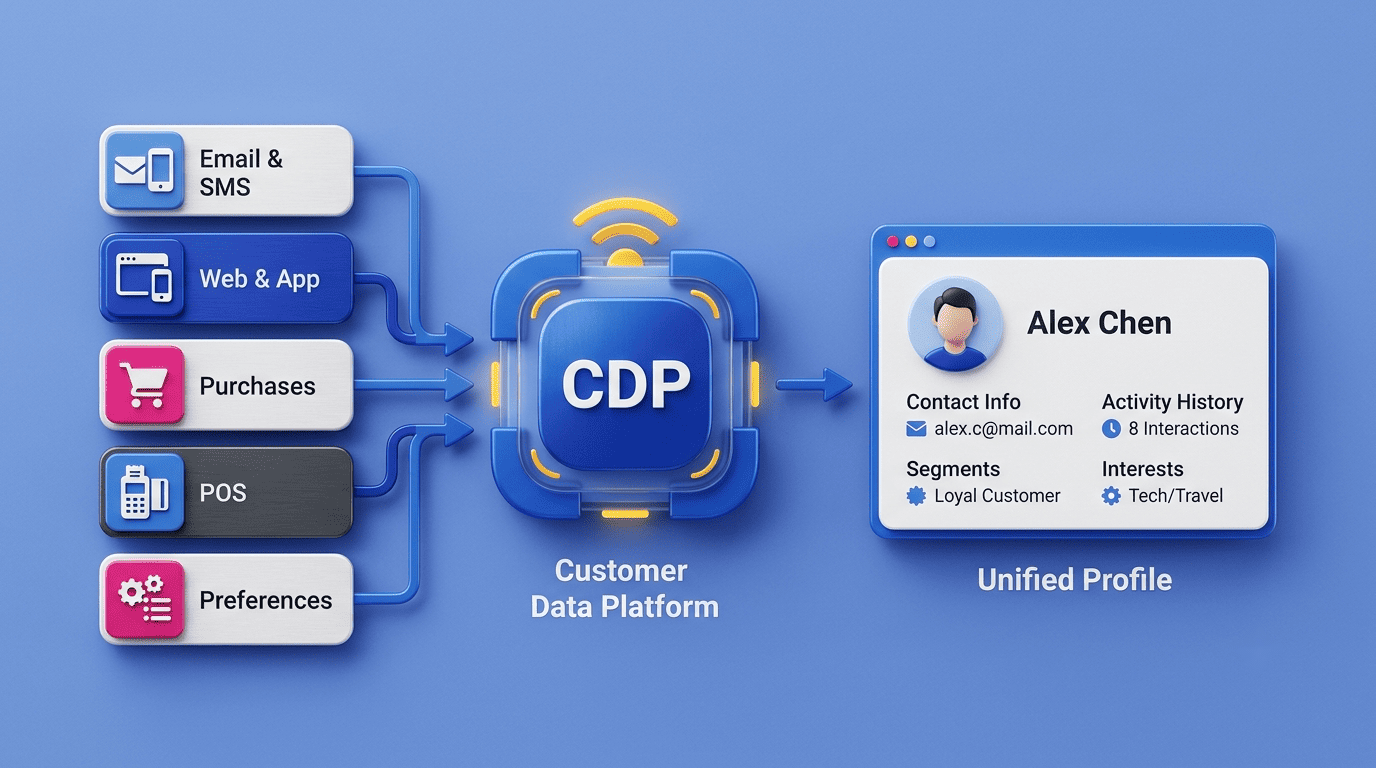
Why data quality decides everything
Garbage in, garbage out applies with unusual force here: without clean first-party data (what customers actually do) and zero-party data (what they explicitly tell you), engines make worse predictions the more scale you throw at them. A customer data platform (CDP) is the layer that pulls records into one profile per customer, typically from:
- Email and SMS engagement history
- Website and app browsing behavior
- Purchase and transaction records
- Point-of-sale (POS) data for hybrid retailers
- Support and service interactions
- Explicitly stated preferences (zero-party data from surveys, quizzes, account settings)
According to Salesforce’s State of Marketing research, nearly two-thirds of marketers say they’re struggling to keep up with changing customer behavior, and 69% say new-customer acquisition is getting harder — both symptoms of fragmented, low-quality data rather than a weak model.
Identity and predictive CLV
Identity stitching links a customer’s activity across devices and channels into a single profile, which is the prerequisite for both personalization and predictive customer lifetime value (CLV) — a forecast of how much a given customer is worth over their relationship with a brand. Retailer FASHIONPHILE’s pricing and prediction tools draw on more than 20 years of accumulated historical transaction data, illustrating how much history a model needs before its forecasts are worth acting on.
For background on the data-management category itself, Wikipedia’s overview of customer data platforms is a useful primer on how the technology evolved out of older CRM and DMP systems.
Key Applications of AI Personalization
Once the data foundation and mechanism are in place, AI marketing automation software shows up across nearly every customer touchpoint rather than a single channel.
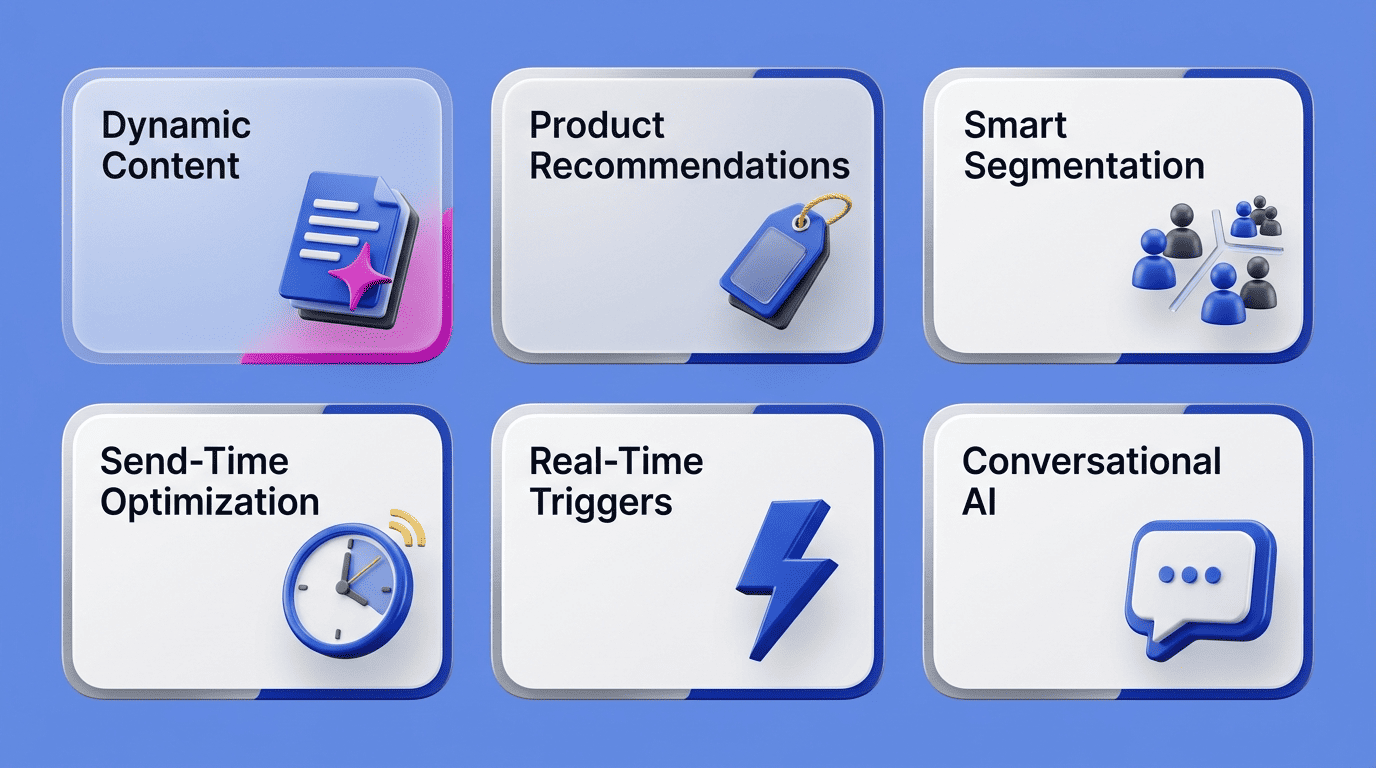
Six ways AI personalizes
- Dynamic content and generative creative. Subject lines, product copy, and images are generated or swapped per recipient rather than written once for everyone.
- Product recommendations. Predictive models rank the items a specific customer is most likely to buy next, based on their own history and similar customers’ patterns.
- Smart segmentation. Machine learning continuously re-clusters customers by behavior instead of relying on static demographic buckets set months ago.
- Send-time optimization. Each message goes out at the hour a given recipient is statistically most likely to open it, not a single blast time for the whole list.
- Real-time triggers. Behavioral events — an abandoned cart, a pricing-page visit — fire a personalized follow-up within minutes instead of a scheduled batch.
- Conversational AI and chatbots. Individualized product guidance and support happen in real time inside the chat window itself.
Eyewear retailer Now Optics used AI-driven personalization across these levers and, according to its published SAP Emarsys case study, saw a 65% year-over-year increase in win-backs from a no-show reactivation journey and a 576% jump in appointments booked from a single AI-personalized reminder campaign.
Real-Time and Omnichannel Orchestration
Personalization only feels coherent to a customer if it’s consistent everywhere they encounter the brand, which is the job of orchestration layered on top of the data and generation pieces already covered.
From reactive campaigns to proactive orchestration
A unified customer profile lets a brand keep the experience consistent across email, web, in-app messaging, and SMS in real time, instead of each channel running its own disconnected logic. Agentic AI — AI agents that can execute multi-step actions autonomously rather than just generate content — increasingly runs these journeys end to end, adjusting the next action based on what happened in the last one. Marketing-automation providers have pointed to companies like Spotify and HubSpot as examples of brands running orchestration this way across channels, coordinating experiences that used to require separate teams per channel.
Risks: Privacy, Authenticity and the Creepy Line
Personalization at scale carries a real failure mode: cross the line from helpful to intrusive, and the same technology that builds trust starts eroding it.
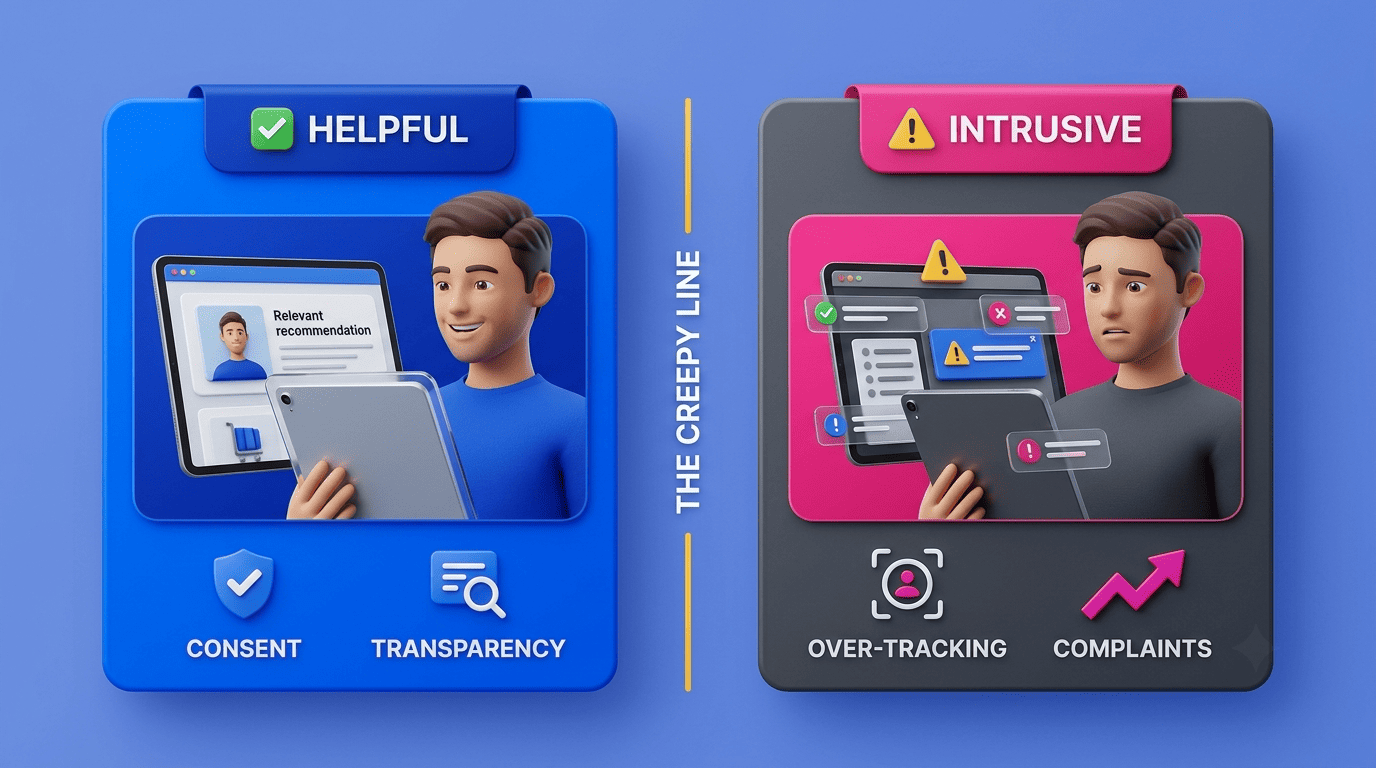
The helpful vs. intrusive boundary
Personalization is supposed to make a customer feel understood, not surveilled. That distinction matters more than the marketing literature sometimes admits: only a small minority of consumers say they explicitly want AI-driven personalization when asked directly, even though the same population responds well to it in practice when it’s subtle. Signs a program has crossed the «creepy line» tend to show up in the same few places:
- A spike in unsubscribes or spam complaints right after a new personalization feature ships
- Customers commenting that an ad or email feels like it’s «reading their mind» in a negative way
- References to purchases or behavior the customer doesn’t remember sharing directly
- Messaging that reveals sensitive inferences (health, finances, relationships) the customer never disclosed
Consent and transparency requirements under frameworks like the EU’s General Data Protection Regulation and the California Consumer Privacy Act aren’t just compliance boxes; they’re a reasonable proxy for what customers will tolerate before marketing automation with AI starts to feel like tracking rather than service.
Best AI Personalization Tools and How to Get Started
Choosing a platform matters less than most vendor comparisons suggest — what matters is whether the tool fits the data you already have and the channels you actually use.
Platforms
Picking a platform comes down to what data and channels you already run, more than feature checklists:
- Salesforce Marketing Cloud / Agentforce — has been named a Gartner Leader for eight consecutive years; best suited to teams already inside the Salesforce ecosystem, with Agentforce adding autonomous-agent execution on top.
- Emarsys (SAP Customer Experience) — focuses on retail and e-commerce personalization through its Personalization Engine and pre-built tactics.
- Klaviyo — commonly used by smaller e-commerce brands that need AI-driven email and SMS personalization without enterprise complexity.
- A standalone CDP layer — sits underneath any of the above, since it’s the actual data infrastructure the personalization logic depends on regardless of which front-end platform runs on top of it.
Getting started (5 steps)
- Consolidate first-party data into a CDP. Pull records from every channel — web, app, email, POS, support — into one place before marketing automation with AI can layer predictive or generative logic on top.
- Build a unified customer profile. Stitch identities across devices and channels so the engine is working from one accurate picture per person, not five fragments.
- Pick your first applications. Start narrow — recommendations, dynamic content, or send-time optimization — rather than attempting all six applications at once.
- Turn on predictive and generative models. Layer predictive analytics for intent and CLV, and generative AI for individualized content, once the data foundation is solid.
- Measure, guard privacy, and iterate. Track conversion and engagement lift against unsubscribe and complaint rates as a built-in check against overreach.
Metrics and ROI: Measuring Personalization at Scale
A personalization program without clear KPIs is impossible to defend in a budget review, and it’s easy to mistake activity (more emails, more segments) for actual results.
KPIs that matter
The metrics that hold up under scrutiny are conversion lift, customer retention, and customer lifetime value (CLTV) — outcomes tied directly to revenue rather than engagement vanity metrics. Engagement and conversion uplift on individual campaigns, like the win-back and appointment-booking gains Now Optics saw, are useful secondary indicators, and revenue per customer captures whether personalization is actually growing wallet share. Alongside all of it, unsubscribe and complaint rate should be tracked as a guardrail: a program that lifts conversion while quietly pushing up complaints is trading long-term trust for short-term numbers, which is exactly the failure mode covered above.
| KPI | What it measures |
|---|---|
| Conversion lift | Whether personalized offers convert better than generic ones |
| Retention / CLTV | Whether personalization keeps customers longer and grows their value |
| Open rate / CTR uplift | Engagement quality of individualized content and timing |
| Revenue per customer | Whether personalization grows spend, not just clicks |
| Unsubscribe / complaint rate | Guardrail against crossing the creepy line |
Getting the data foundation, applications, and orchestration right is what separates AI marketing automation software that actually moves these numbers from a personalization pilot that never leaves the sandbox.